Binary options: what they are, how they work and what to know before you start
How binary options are built, how they differ from “vanilla” options and other markets, what their legal status is across countries, and what to look at when choosing a platform.
Contents
Before digging into strategies and indicators, it is worth understanding the instrument itself: how a trade is built, how binary options differ from other markets, and why their status varies from country to country. That is what this article is about. Definitions of individual terms live in the academy glossary — gathered in one place, searchable, with examples.
A brief history of the appearance of binary options.
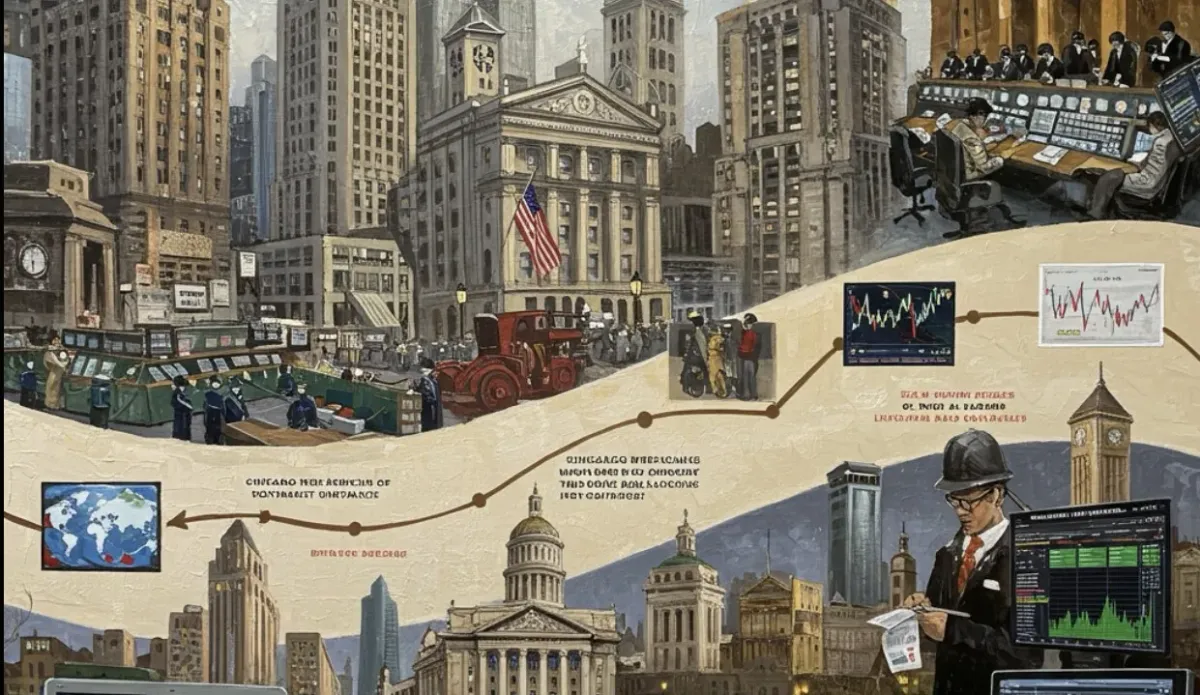
The first mentions of binary options date back to the early 20th century in the context of the development of US financial markets. The Great Depression period gave birth to many new derivatives, most of which turned out to be overly risky and poorly predictable, so over time they disappeared.
Options trading as a whole survived and began to be perceived as a promising tool. In 2008, in the USA, regulators allowed the exchange launch of certain binary contracts. After that, the Chicago Board Options Exchange (CBOE) and the North American Derivatives Exchange (Nadex) began offering standardized binary options to retail traders.
In the 2010s, binary options became more accessible to the general public through numerous online platforms, including unlicensed ones. This led to a sharp rise in popularity thanks to the simplicity of the interface and the idea of a “quick” result. At the same time, regulatory oversight increased due to the high level of risk and cases of fraud by unscrupulous brokers.
Current status and regulation
Today there are three main categories of options as financial instruments:
- Exchange-traded options — classic “vanilla” options traded on regulated exchanges.
- Regulated binary options — available only on regulated venues.
- Unregulated binary options — online platforms without oversight by authoritative financial bodies.
Most beginners and many experienced traders use unregulated binary options due to wide availability, simplicity, and a low entry threshold. This does not mean that users are obliged to lose money, however the risk is significantly higher, and service quality depends on the broker’s integrity. Among unregulated companies there are participants who have fulfilled obligations for years and have a wide client base, but the choice of partner must be especially careful.
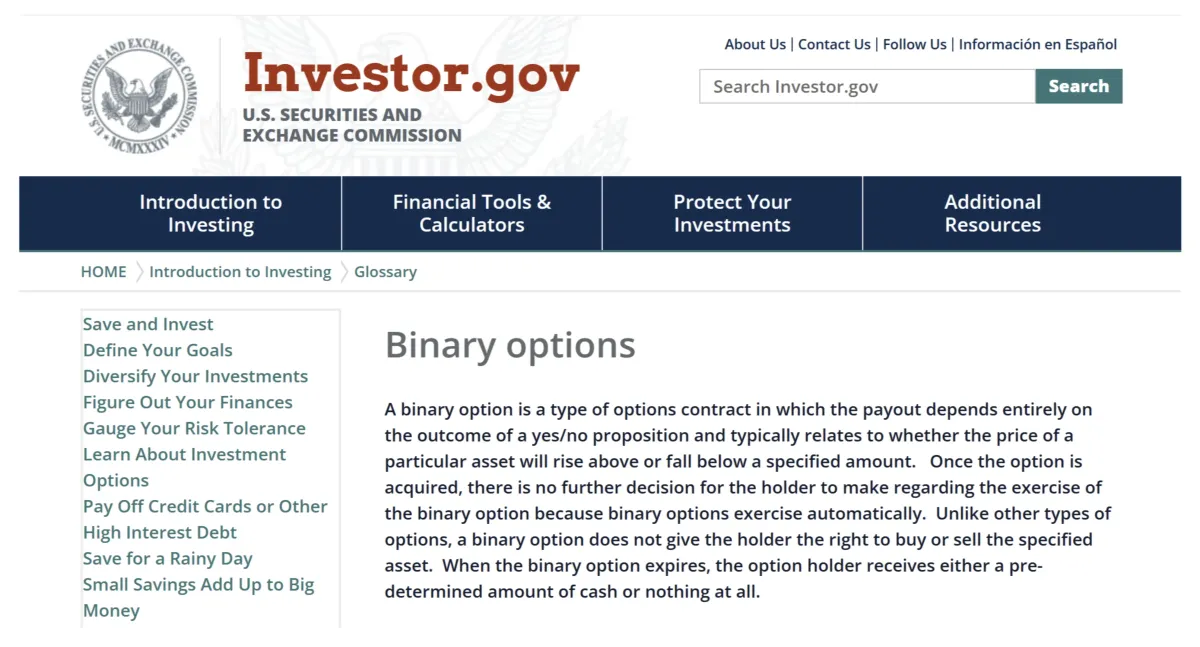
On the website of the U.S. Securities and Exchange Commission (SEC), binary options are described as a fully-fledged but high-risk trading instrument.
Learn for free
How binary options differ from “vanilla” options and other markets
In traditional exchange “vanilla” options, you buy a contract with a price that depends on how much the underlying asset changes. In binary options you do not become the owner of the underlying asset and do not calculate a complex payout. The result is a fixed payout if the forecast of direction is correct by the moment of expiration, or the loss of the trade amount if wrong. This difference makes binary options simpler in mechanics and allows you to assess potential profit and loss in advance. That is what distinguishes them from the forex market and from the crypto and stock markets.
Regulation by countries and warnings
Today, trading in binary options falls under legal norms in many countries. This increases transparency and safety on regulated venues. At the same time, a number of regulators publish risk warnings, and in some jurisdictions binary options are restricted or prohibited.
Nevertheless, despite the controversial status in certain regions, binary options remain an attractive tool for experienced traders who consciously approach risk and use proven strategies with statistics taken into account.
Practical recommendations for choosing a platform
- Check the broker’s reputation based on independent sources and the company’s lifetime.
- Study the conditions for deposits and withdrawals, commissions, and order processing speed.
- Start with a demo account and a fixed trade size.
- Do not use high-risk strategies without systematic risk management.
- Clarify tax obligations at your place of residence before starting to trade.
Where to find the definitions
Terms live in a section of their own — the academy glossary. They are grouped alphabetically and searchable, which beats hunting for a word inside an article.
The key concepts have pages of their own, with examples and calculations:
- payout — what a winning trade brings and what sets the percentage;
- expiration — the moment a trade closes automatically;
- win rate — the share of winning trades, and why half is not enough;
- drawdown — the decline from a peak and the math of recovery;
- martingale and Masaniello — methods of managing the trade size;
- OTC — over-the-counter assets available at weekends.
To put numbers on any of it, use the academy calculators: breakeven win rate, position size, compound interest and a breakdown of the money-management methods.
Where to start in practice
Step 1. Parse the basics
Go through the glossary, starting with the money-management terms. Fix simple risk rules.
Step 2. Choose indicators
For example, 1–2 indicators or trading bots. Do not overload the chart.
Step 3. Assemble a simple setup
Describe in words the conditions for BUY/SELL and expiration. Form a checklist, writing it down in a notebook.
Step 4. Test on demo
Trade one strategy for at least a week and record the results.
Step 5. Connect analytics
Watch WR, Profit Factor, expectancy. Change one parameter at a time.
No. In trading, decisions are made according to rules and statistics, not “by luck”. However, risks are high, discipline and learning are mandatory.
Create an account and pass verification, switch to demo, choose one simple setup and collect statistics. Keep the trade size fixed.
No. For a start, simple tools and clear rules are enough. Increase complexity gradually.
Tools and learning — BinoView
Charts, signals, a bot constructor, and educational materials for a calm start.