SR Bot Original on 10 Seconds: Auto Trading Settings for Pocket Option
Auto trading with the SR Bot Original on a 10-second OTC chart: first trade $90, martingale 2.2 over six steps, 10-second expiration, take-profit instead of a stop-loss. Why not $100, the previous day's statistics (74 trades, +$2,374), a breakdown of the recording with +$1,175, plus the author's thoughts on trading with your last money.
Contents
In this video Nick launches the SR Bot Original, shared by a team partner, on a real account, and while the bot works he talks about how the fear of losing money breaks trading. Below are the auto-trading settings with every parameter explained, the previous day's statistics, a breakdown of the recording and the key points from the talk about the "scarcity mindset".
What the bot is
SR Bot Original is a signal strategy from a team partner who traded its signals both by hand and in Auto mode, then shared the result. The bot's card on the chart shows the BOTH signal mode, an EMA 50 filter and the win rate for the current asset. The author does not break down the bot's rules in the video: he takes it as a ready tool, sets his own money management and runs it on a real account.
The day before the recording the same setup brought the author $2,374.53 over 74 trades, and he shows the statistics right in the Pocket Option profile: 49% profitable trades, turnover $15,461. The auto-trading history shows two sessions that reached the $1,100 take-profit: one with 22 trades (12 wins, 10 losses, +$1,145.60) and one with 18 trades (8 wins, 10 losses, +$1,114.61).
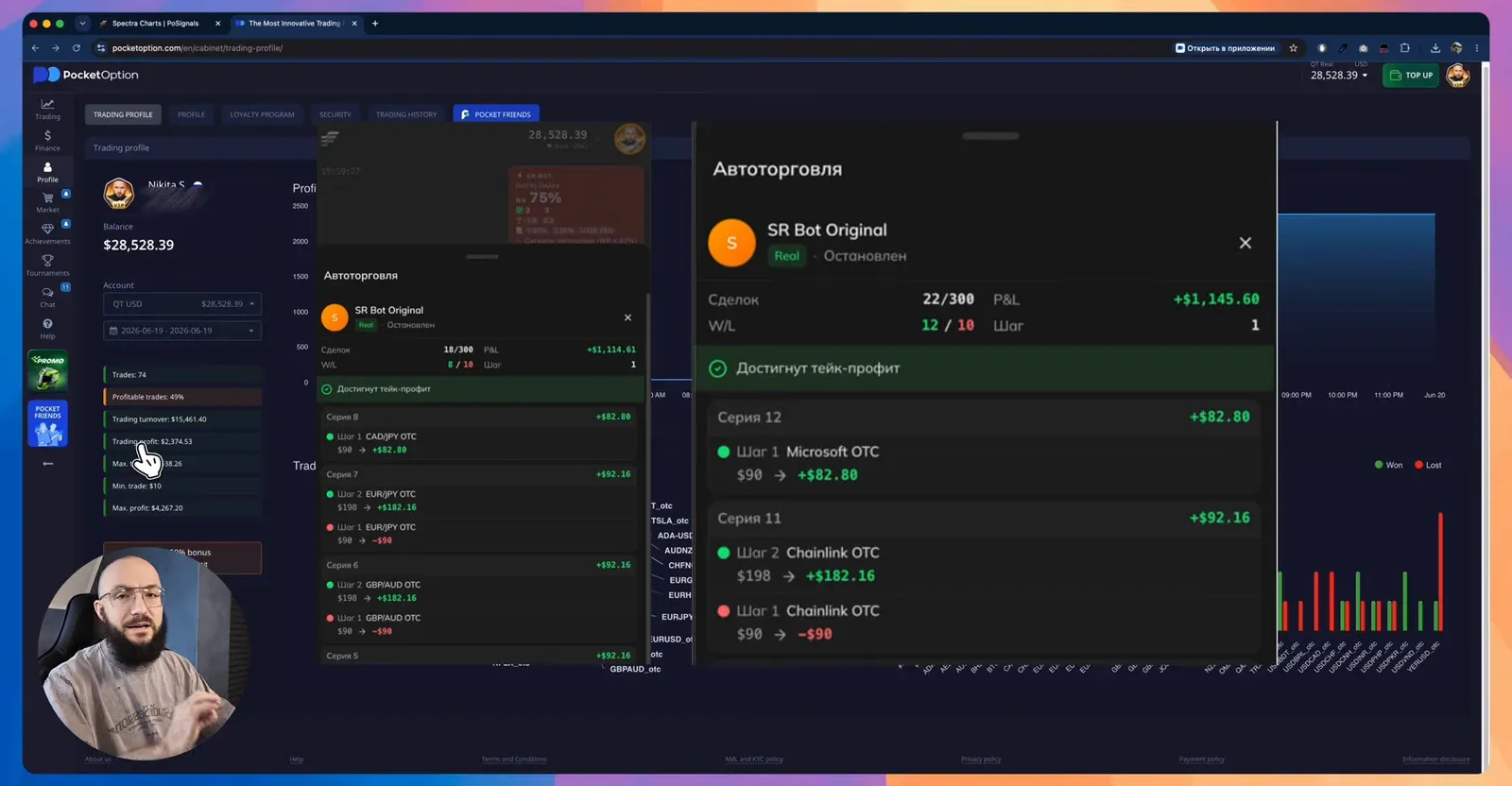
Note the 49%: a win rate below half and still a profitable day. That is how martingale works: one recovery closes the series, and accumulated risk pays for it. What this means over a long run is covered in the money management article.
SR Bot Original and other tools — in BinoView Supercharts
Auto-trading settings
Chart timeframe S10, OTC market with 90–92% payout, 15 screens open. Everything else is set in the Auto window.
| Parameter | Value from the video | Author's comment |
|---|---|---|
| Account | real, $28,528 | |
| Strategy | martingale | |
| First trade | $90 | with $100 the sixth step would exceed the $5,000 trade limit |
| Coefficient | 2.2 | |
| Maximum steps | 6 | caps the series loss instead of a stop-loss |
| Trade opening | on the next candle | |
| Expiration | 10 seconds | the trade lasts one S10 candle |
| Min. payout | 90% | |
| Auto-switch low-payout pairs | on | the asset changes as soon as the payout drops |
| Auto-switch all pairs | every 3 minutes | |
| Maximum trades | 300 | "in practice it will be about 30 trades" |
| Recover on the same pair | 1 | after one recovery the bot moves to another asset |
| Take-profit | $1,100 on screen, raised to $2,500 before launch | triggered twice the day before |
| Stop-loss | off |
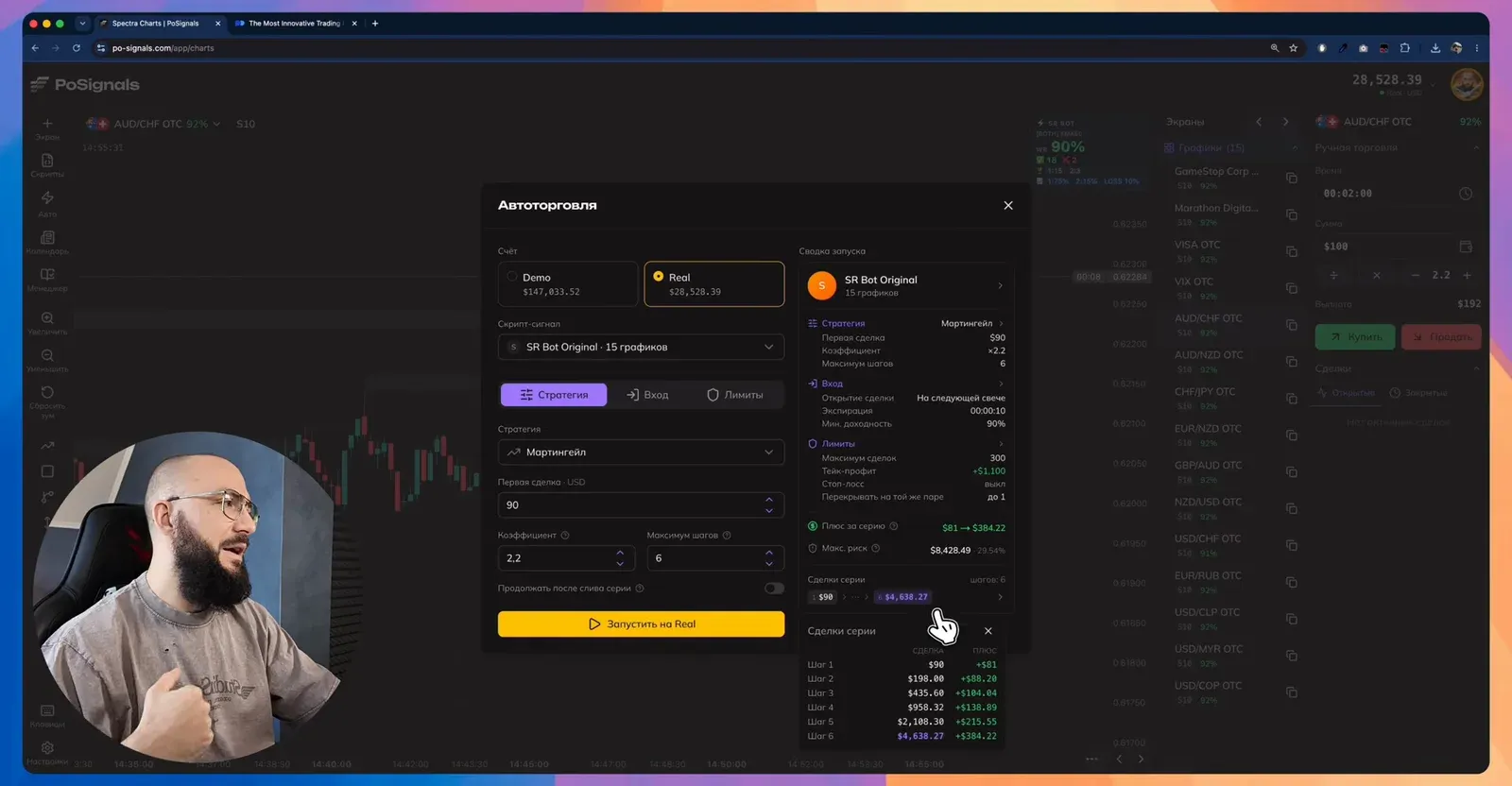
The series table in the summary shows what $90 turns into at coefficient 2.2:
| Step | Trade size | Profit when the series closes |
|---|---|---|
| 1 | $90 | +$81 |
| 2 | $198 | +$88.20 |
| 3 | $435.60 | +$104.04 |
| 4 | $958.32 | +$138.89 |
| 5 | $2,108.30 | +$215.55 |
| 6 | $4,638.27 | +$384.22 |
The sum of all six steps, that is the price of one lost series, is shown on the "Max risk" line: $8,428.49, or 29.54% of the deposit. In the talk the author rounds the risk to "about $4,500", meaning the last step, but the platform counts more honestly: a lost series burns all six trades.
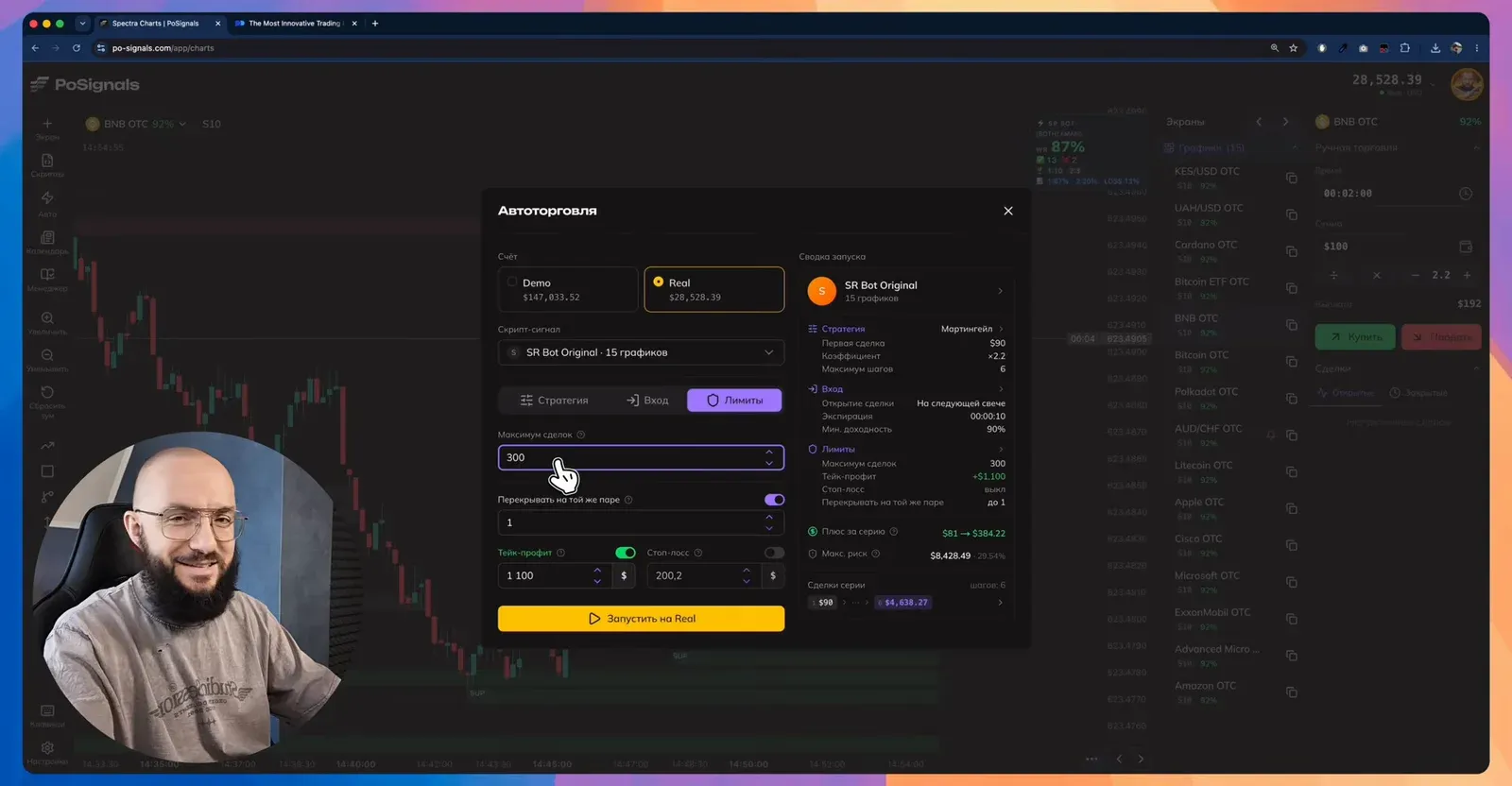
1 + 1/payout; at 90% that is 2.11, so the 2.2 from the video works with a small margin.Checklist before the start. The auto-trading window has a list of quick checks: it highlights a setting if, for example, you want trades to open right on the signal rather than on the next candle, or have enabled recovery on the same pair. The author advises going through it every time, since settings cannot be changed after launch.
Breakdown of the recording
The bot was launched on the real account at 14:55 terminal time. The first series immediately showed the typical picture: first trade a loss, recovery a win. The author points this out twice: "the first is often a loss, the second more often a win, literally 50/50".
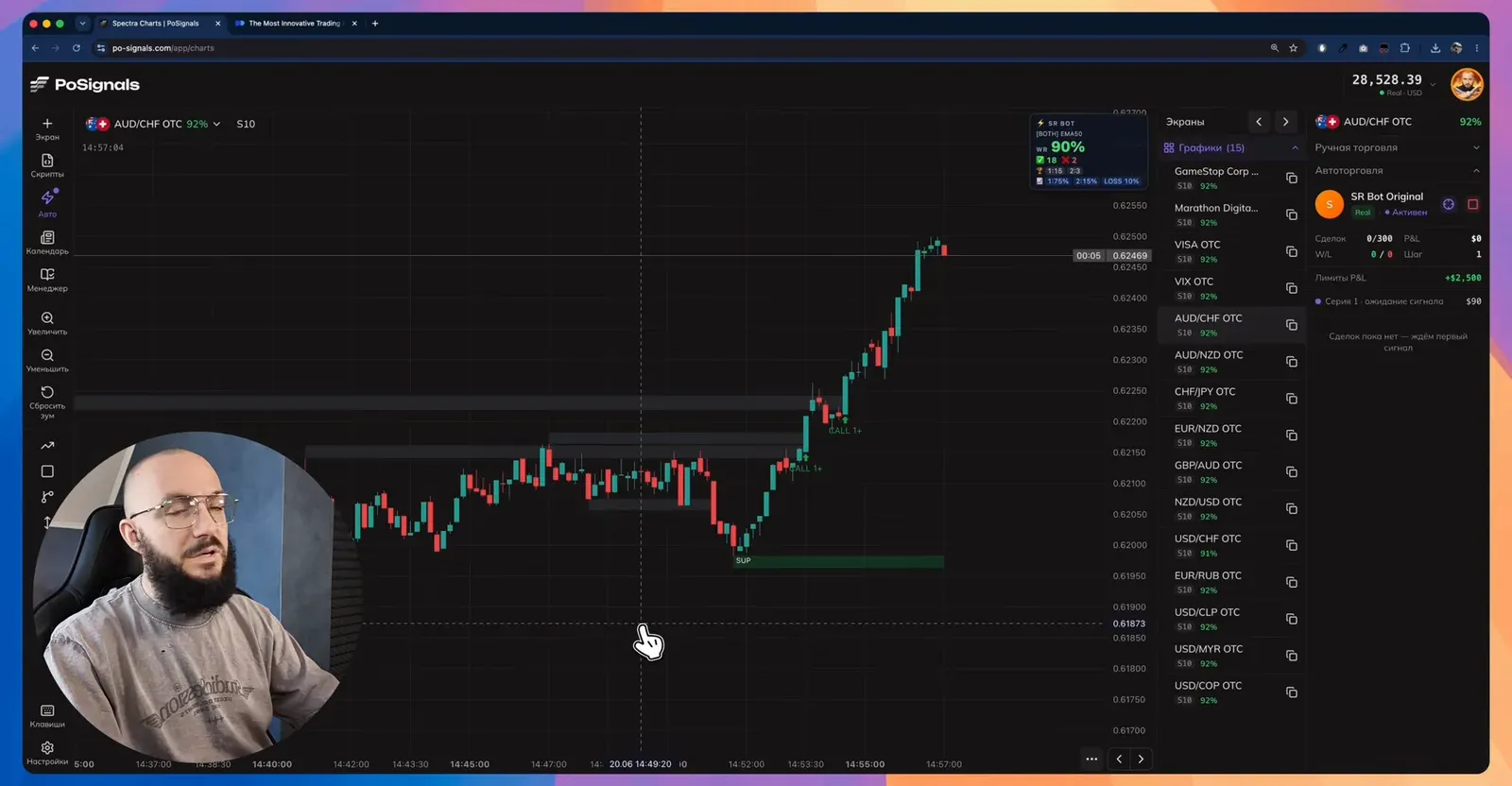
Then, as the talk goes on: +$812 by the middle of the recording, then a series with a refund and a $182 win, then the bot "dragged into the red" and recovered, passing $1,000. The $2,500 take-profit was not reached. The author stops the bot by hand at +$1,175.55: 25 trades, 12 wins, 12 losses and one refund. The balance grew from $28,528.39 to $29,703.94 in roughly 15 minutes of recording.
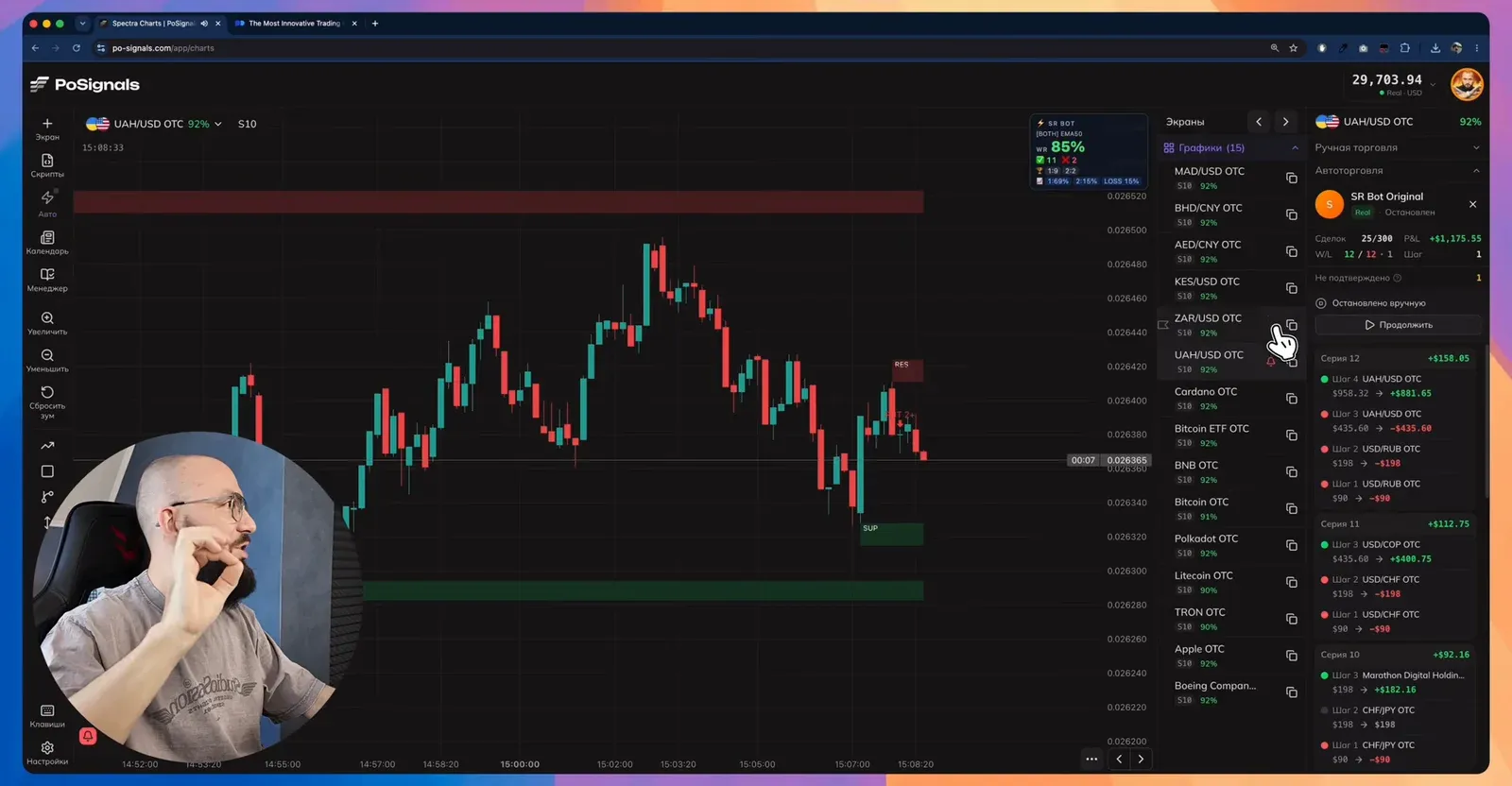
This is the result of one recording, not an expected return. The same auto-trading history holds sessions with 10 losses out of 22 trades, where the profit comes from recoveries alone. Ten-second trades on OTC are the fastest scalping possible, and in the author's words the bot needs supervision in this mode: "you have to step in on time, or spread the risk so that you can stop in time if it goes wrong". More on synthetic quotes in the OTC article.
The scarcity mindset: what the author talks about
The second half of the video is not about the bot. While it trades, Nick explains why trading with your last money almost always ends in a blown account.
- Fear blocks the strategy. When the account holds "the last" money, a trader skips profitable signals, recovers losses without a signal and waits for a miracle instead of following the rules.
- Money on the account is a working tool. The author compares it to fuel: nobody cries over every litre. The deposit should consist of spare money you can lose without consequences for your life.
- Write the goal down. Not abstract millions, but a specific amount and deadline. The author tells his own story: he bought a car on credit while still learning to trade and paid it off early by the end of summer from trading profits, having lost more than 15 million rubles in someone else's scam project along the way. He stresses separately that he is not urging anyone to take out loans; it is only an example of how a concrete task changes your attitude to work.
- Visualisation without daily work is self-deception. Inner attitude is half the result; the other half is hours at the monitor, strategy tests and risk control.
- Withdraw part of the profit. If the brain does not see what the numbers on screen turn into, it burns out. Earned something, withdraw a part and spend it on yourself or your family.
How to cap losses in advance rather than by mood is covered in the articles on the daily loss limit and money management.
FAQ
Why is the first trade $90 and not $100?
Because of the trade size limit on the platform tier. With $100 the sixth martingale step at coefficient 2.2 requires $5,153, while the maximum on the author's VIP tier is $5,000, so the series would break on its last step. With $90 the sixth step is $4,638 and fits the limit. Check your own limit before launching.
Do I need a stop-loss if martingale is on?
The author does not set one: with six steps the maximum loss of a series is already capped, in the video it is $8,428 on the 'Max risk' line. A stop-loss is mandatory for other strategies, such as compensation recovery or anti-martingale, where the series does not limit itself.
Why does the first trade of a series so often close as a loss?
It is a feature of signals on a 10-second chart: the entry happens on the next candle after the signal, and price often manages a step against it. The author notes from his statistics that a series usually closes in profit on the first or second recovery, so he keeps one recovery on the same pair and then the bot moves to another asset.