Trading Psychology: Nine Traps That Break a Working Strategy and Seven Habits Against Them
Why traders lose money even with a working strategy: the urge to recover a loss, a winning streak, fear, boredom, other people's results and hoping a bot will fix it. The math of 10 trades of $100 at a 90% payout, how many winning trades you need to break even, and seven simple habits: written rules, a daily target and stop, a pause after a loss, a trading journal.
 Nick 10 min read
Contents
People lose money everywhere: on binary options, on Forex, on crypto. And the reason is almost always the same. It is not in the chart or the indicators but in the trader's head. You can take a good strategy, calculate the amounts correctly, set limits and still end up in the red, because an ordinary person sits at the terminal, with their own mood, fatigue and temperament. Below we go through the nine traps almost everyone falls into, do some simple math and put together seven habits that keep you from breaking your own strategy.
Why a strategy breaks away from the chart
A familiar picture. You sit down to trade, the first trade closes in profit, the second one too. You are in a great mood. The third closes at a loss, the fourth at a loss again, and nothing is left of the earlier profit. Your head is no longer on the strategy but on one thought: "I have to get it back." A bigger amount, a faster entry, a setup that "looks kind of similar". Half an hour later the person is no longer trading but trying to recover their money.

Notice that nothing here says what is being traded. On options, crypto or the stock exchange this scene looks the same. Hence a working rule from the channel: trading is about 80% head and only 20% strategy. This part gets talked about the least, even though it decides the most.
The nine traps at a glance
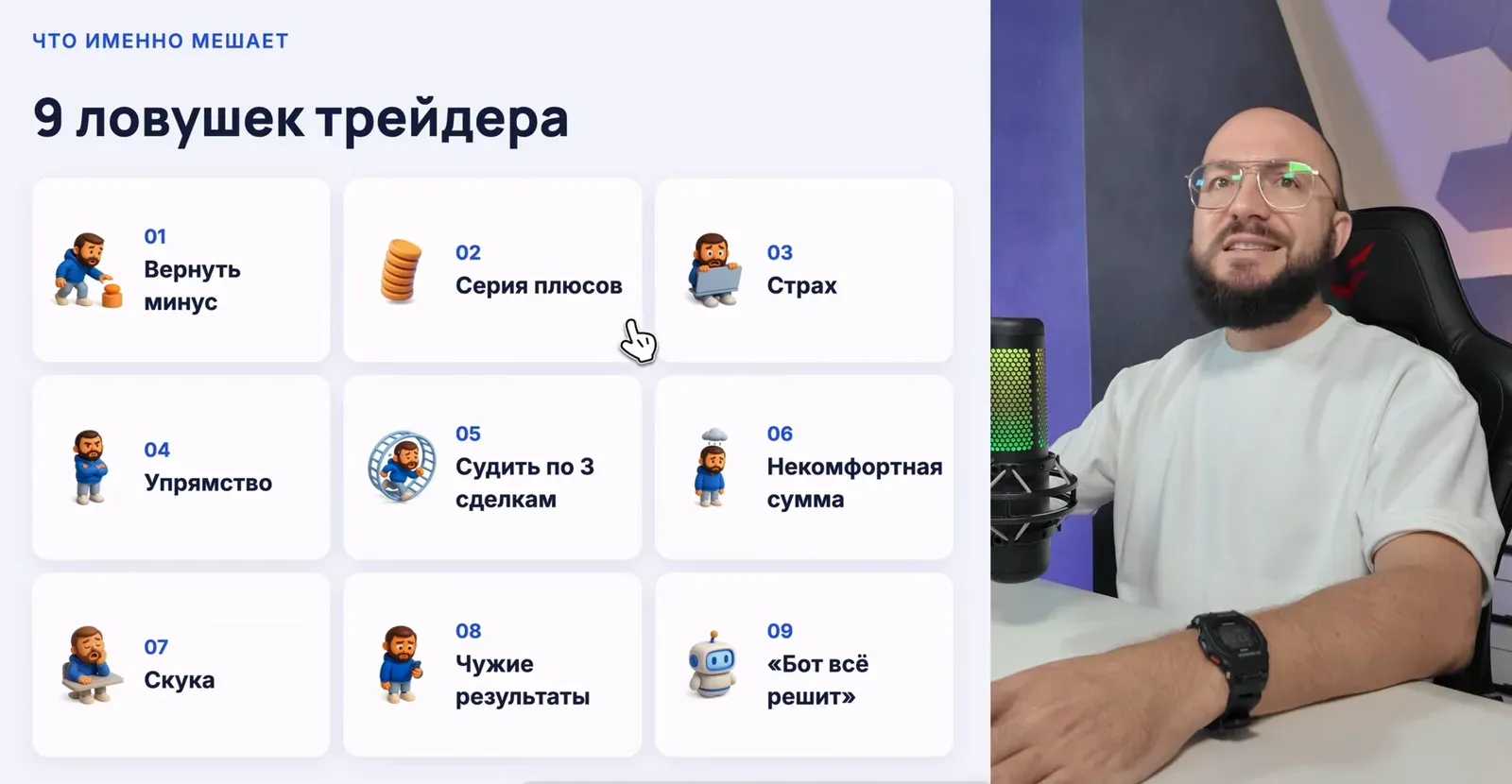
| Trap | How it shows | What to do |
|---|---|---|
| Recovering a loss | right after a loss, the next trade is bigger and has no signal | a pause after a loss, a fixed amount |
| Winning streak | after five wins the amounts grow and entries appear that you would have skipped before | the trade amount does not depend on mood |
| Fear | there is a signal, but you wait one more candle and enter after the entry point is gone | rules on paper: conditions met, you enter |
| Stubbornness | "it's about to reverse, I can see it" — an entry against your own rules | admit the mistake and move on |
| Judging by three trades | three losses in a row, then a search for a new strategy, round and round | judge by hundreds of trades |
| Uncomfortable amount | one loss ruins the whole evening, your hands shake on a live account | lower the amount until you are calm |
| Boredom | an hour without a signal, then an entry "somewhere" | skipping a trade is also a decision |
| Other people's results | screenshots of other people's profit and an urge to catch up fast | compare yourself only with your own plan |
| "The bot will fix it" | the bot is switched off after the first loss or amounts are raised above the plan | at least three tests at comfortable amounts |
None of these traps is solved by a new indicator. It all happens in your head, not on the chart. A trading journal shows this clearly: after a week of entries you can see which losses followed the strategy and which came from emotions.
The nine traps one by one
1. The urge to recover a loss
A trade closed at a loss, say $20. It is unpleasant, and you immediately want to open the next one bigger to recover it. There is no signal, but your hand is already reaching for the button. Such a trade almost always ends in a loss, because it was opened out of inner discomfort, not by the strategy. A loss on its own does not drain a deposit. What drains it is what a person does right after. The state in which irritation is making the decisions is called tilt.
Speed. The issue is not the platform but the trade length. A one-minute binary options trade closes on its own at expiration, and you see the result immediately. In an hour you collect dozens of such results, and every loss feels like it needs to be recovered fast: it seems you can make it back within the same minute. But you can lose just as fast. When a trade lasts half an hour, there is time to breathe and think, while on short trades you need to watch your pace especially closely. The platform will neither give you a pause nor take it away — it is your decision.
Some partners close 300–1,000 trades a day by hand. Starting at that pace is a bad idea: with so many trades your head cannot keep up with the information, and emotions start making the decisions.
"Get back to zero by evening". The day went wrong, you are in the red, and instead of closing the terminal you sit there until night just to finish at least at zero. You are tired, angry, and the amounts grow. Such an evening usually ends with a loss several times larger than the one during the day — and that is if anything is left of the deposit. A losing day is no reason to sit until night.
2. A winning streak
Oddly enough, it is more dangerous than a losing streak. Five wins in a row and you feel you have figured it all out. Extra confidence: the amounts grow, entries appear where you would have simply waited before. Then one losing trade on a big amount, and the day's profit is gone. That is still the best case: it is worse if part of the deposit goes along with the profit.
3. Fear
The flip side. After a couple of losses it becomes scary to press the button. There is a signal, everything matches your rules, and you sit and do not enter. Or you wait for one more candle to be sure and enter when the entry point is already gone. As a result the strategy works but the result is poor, because you are breaking it yourself.
4. Stubbornness
The thought in your head: "It's about to reverse, I can see it." The market does not care what you see. It does not know you want to enter a trade, and it owes you nothing. The people who stay in trading are those who can calmly admit a mistake and move on, rather than prove themselves right to the market with the next trade.
5. Judging a strategy by three trades
You have a strategy, you start testing it, and you get three losses in a row. "That's it, it doesn't work." The strategy is dropped, the search for a new one begins, and so on in a circle. It never gets to a proper number of trades, and you never find out whether the strategy actually worked. The math in the next section shows why this is a mistake.
6. An uncomfortable trade amount
A simple check: if a loss on one trade spoils your mood for the whole evening, the amount was too big. Not for the deposit, but for you personally. At that amount you can no longer think calmly, and all the other traps kick in twice as hard.
The gap between a demo and a live account belongs here too. On demo everything works, on a live account your hands shake, even though the strategy is the same. To your head these are different money. So after demo, start on a live account with minimum amounts and raise them gradually as you get used to it. How to choose an amount for your deposit is covered in the post "How much money to start trading with".
7. Boredom
You sit for an hour, no signal. You start looking for any setup at all and entering somewhere, just so something happens. Trades out of boredom are usually the most expensive. Skipping a trade is also a decision, and sometimes the best one.
8. Other people's results
Someone posts a screenshot with a big profit, someone has a success story, it seems everyone around you is making money while you still cannot get started. You want to catch up fast — and the wrong decisions begin. Crypto shows this best: in moments of general euphoria many people enter with high leverage, and then the news reports hundreds of millions in liquidations overnight. There people call it "that's the market, it happens to everyone", but when the same thing happens on options, they blame the broker. Yet the cause is the same: entering on emotion so as not to miss out on profit.
9. "The bot will fix it"
A bot really does open trades without emotions, but a person still sits behind it. You run the first test, get a loss and switch it off at once. You get a winning streak and raise the amounts above the plan. Or you start opening manual trades on top of the bot. People often launch a bot hoping it will solve every problem and they will not have to learn charts themselves, and after a loss "the algorithm is to blame". The bot does its part of the job honestly, but the head breaks everything again. Test a bot for at least three runs in a row and at amounts that will not hurt your pocket. Bot reviews are collected in the Bots section.
Learn for free
The math: why you do not judge a strategy by three trades
On binary options the result is known in advance. The right direction brings a fixed percentage of the trade amount (the payout). The wrong direction costs the whole trade amount. The win is smaller than the loss, and that changes everything.
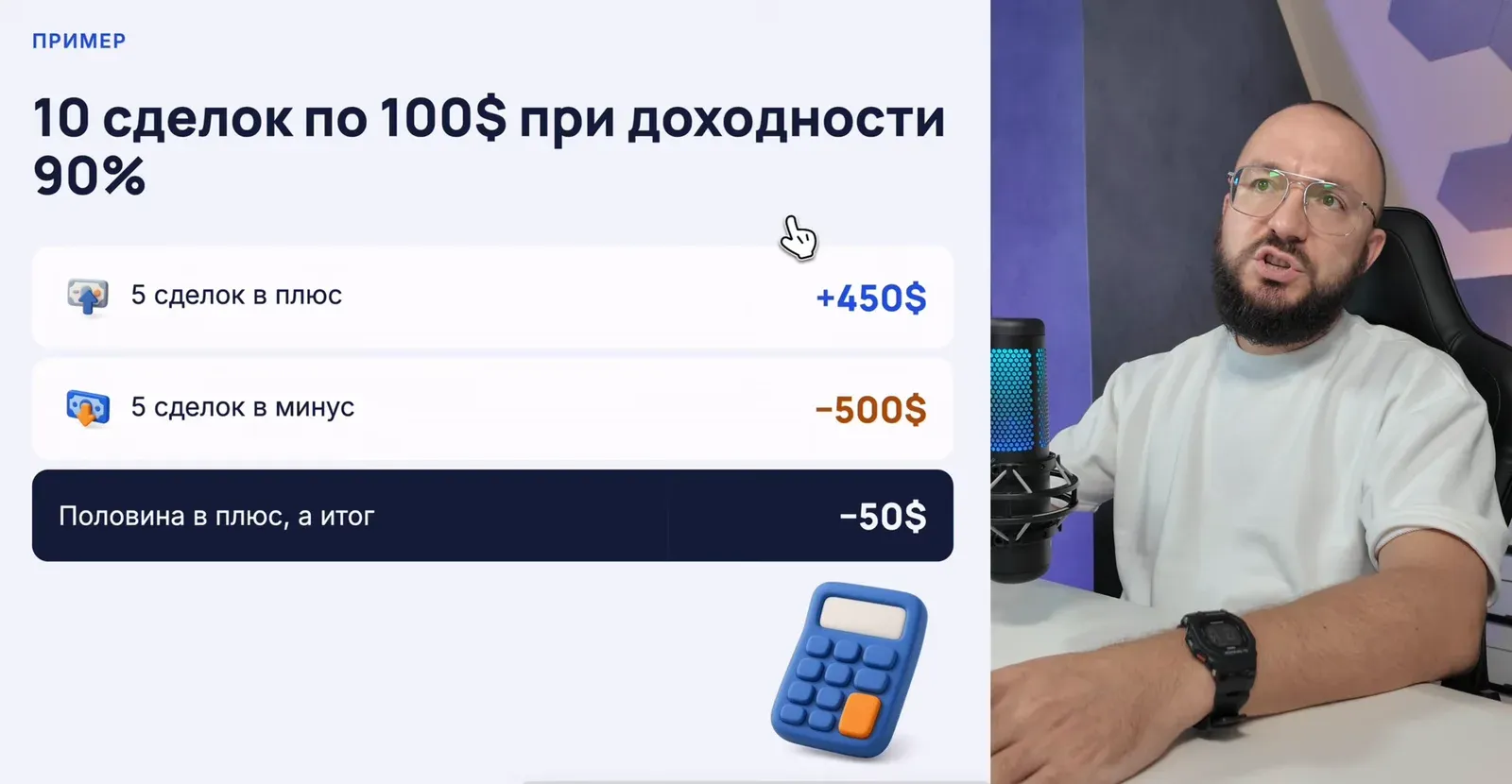
Take 10 trades of $100 at a 90% payout, half of them winning and half losing:
| Trades | Calculation | Result |
|---|---|---|
| 5 winning | 5 × $90 | +$450 |
| 5 losing | 5 × $100 | −$500 |
| Total | half winning | −$50 |
To break even with a fixed trade amount, more than half of the trades must win. The threshold is 1 / (1 + payout):
| Payout | Breakeven, % winning trades | Out of 100 trades |
|---|---|---|
| 92% | 52.1% | 53 |
| 90% | 52.6% | 53 |
| 85% | 54.1% | 55 |
| 80% | 55.6% | 56 |
At a 90% payout, 55 winners out of 100 trades of $100 give +$450, or $4.50 per trade. That is why "55 out of 100 and above" makes sense as a margin over the threshold. You can work out the threshold for your asset's payout in the breakeven calculator. More about the metric is in the article on win rate (the share of profitable trades).
What follows from this: even a good strategy with 60% winners has 40 losses in every 100 trades. At a 90% payout such a strategy makes about +$1,400 over 100 trades of $100, but its losses do not alternate one by one — they come in streaks mixed with wins.
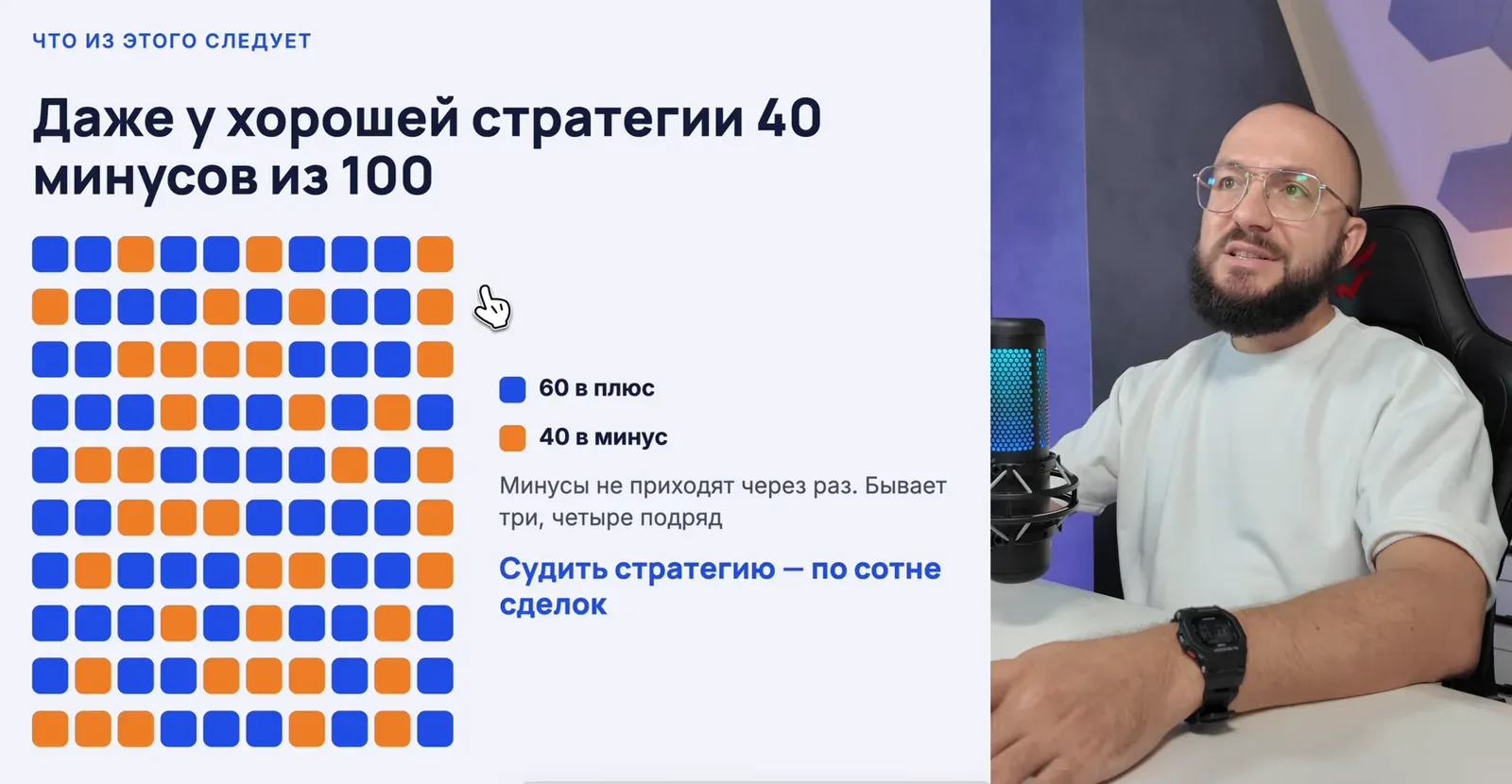
We checked this with a simulation: for a strategy with 60% winners, a streak of at least four losses in a row occurs in about 80% of 100-trade stretches, and a streak of five in 46%. Three or four losses in a row are a normal part of the work, not a verdict on the strategy. You can only judge it by hundreds of trades.
On crypto, for comparison, the math is different: there you can be wrong more often than right and still make money if one profitable trade covers three losing ones. That is why a strategy cannot be moved one-to-one from one market to another. The rules of the instruments differ, but the trader's head is the same.
Seven habits that hold a strategy together
There is nothing complicated here: these are simple habits.
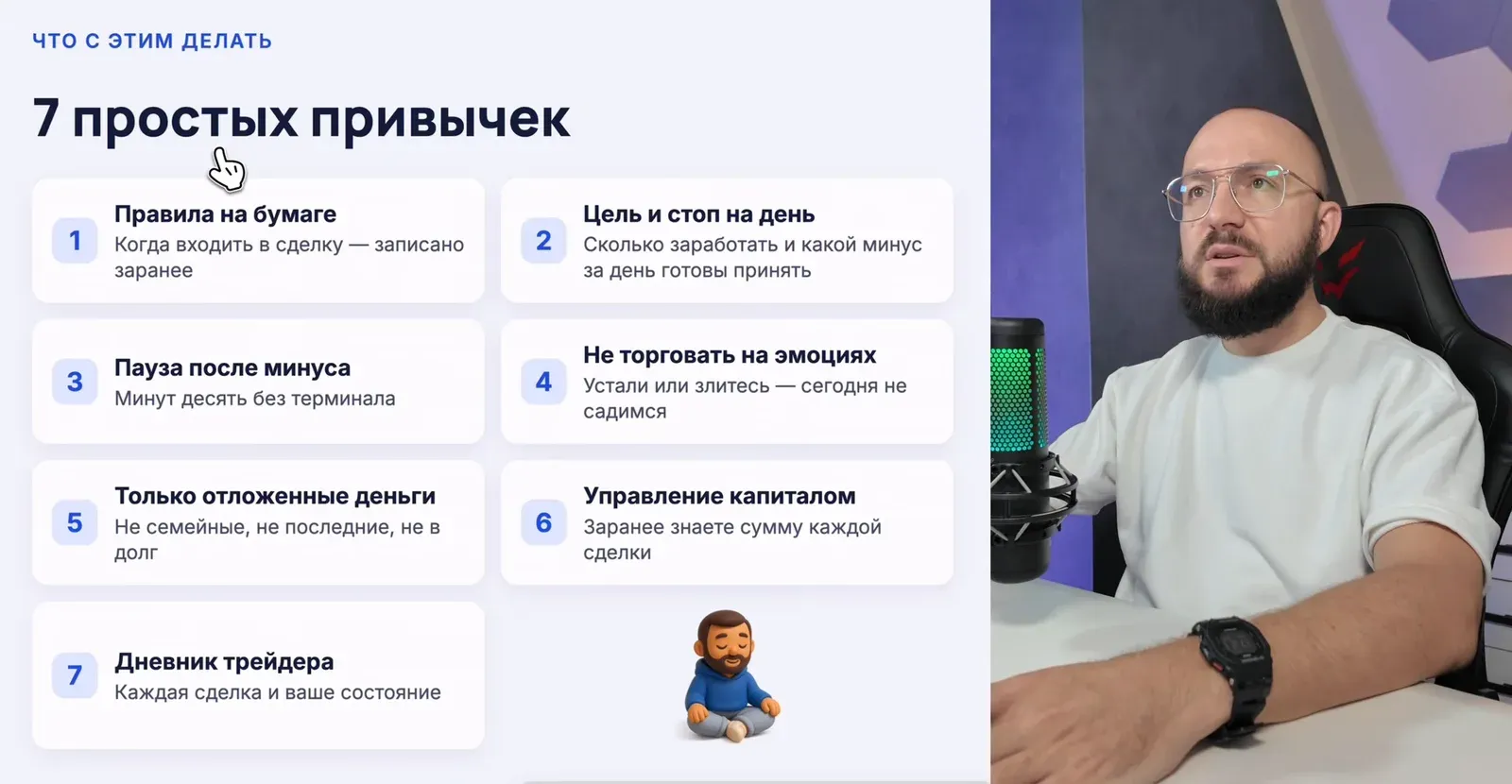
1. Rules on paper
Not in your head, but on a sheet of paper or in a notebook next to the monitor. A list of conditions under which you enter a trade. Not "looks kind of similar", not "clearly going down here", not "I'm sure". If even one condition is not met, there is no trade. When emotions kick in, your head starts to deceive you, but the sheet does not: you simply go through the checklist.
2. A daily target and stop
Before you start trading, decide two things: how much you want to make and what loss for the day you are ready to accept. For example, a stop of 3–5% of the deposit and a target of +10%. With a $500 deposit that is a $15–25 stop and a $50 target. Reach either number and you close the terminal and go rest. Not "I'll try to stop", but close it. This rule will save you more money than any indicator or bot. More in the article on the daily loss limit.
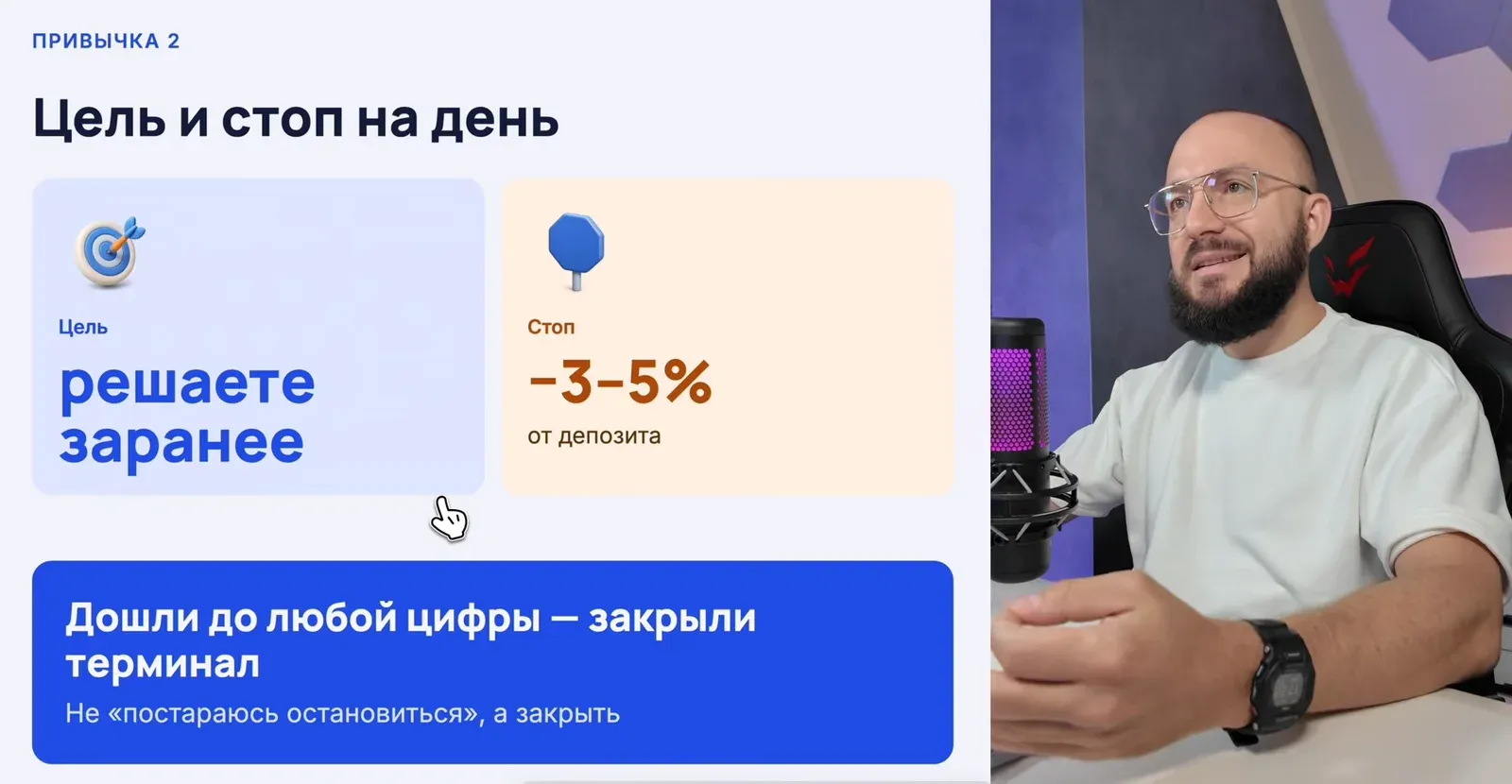
In the BinoView trade manager the session target and stop-loss are set in percent in advance, and the timer ends the session on its own, so you do not have to talk yourself into stopping.
Set a calm target. Someone who sits down thinking "I'll double my deposit in a week" will open extra trades and raise amounts to make it in time. Such a target puts pressure on you, and you cannot trade properly under pressure.
3. A pause after a loss
Get up, make some tea, walk around for about ten minutes. It sounds funny, but it is the simplest cure for the urge to recover a loss. After the pause you may decide not to enter the market again today at all — and that is a perfectly fine outcome too.
4. Do not trade tired, angry or upset
You argued at home, slept badly, have problems at work — better not to sit down today. The market is not going anywhere: tomorrow it will be there just as it is today and has been for years.
5. Only money set aside for trading
Trade only with money set aside specifically for this. Not family money, not your last money and certainly not borrowed money: no debts and no loans. When you are afraid of losing money you need to live on, you cannot trade calmly. And when money is short, a chase for profit by a certain date begins — along with trades on emotion.
6. Money management
Know in advance what amount you open each trade with. There are many approaches: a fixed amount, a percentage of the deposit, martingale, a recovery trade, anti-martingale. The key thing to understand about any of them: money management will not turn a losing strategy into a profitable one. It preserves what a working strategy earns and helps grow the deposit faster.

So the order is:
- Practise the strategy.
- Find out your percentage of winning trades over the long run.
- Only then choose money management for that strategy — one where the trade amount does not scare you and a losing streak does not break the deposit.
7. A trading journal
Record every trade: which strategy you used, whether you followed it and what you felt when you opened it. Open the records after a week and you will see that most of the losses happened not by the strategy but on emotion. It becomes visible as soon as you start keeping records.
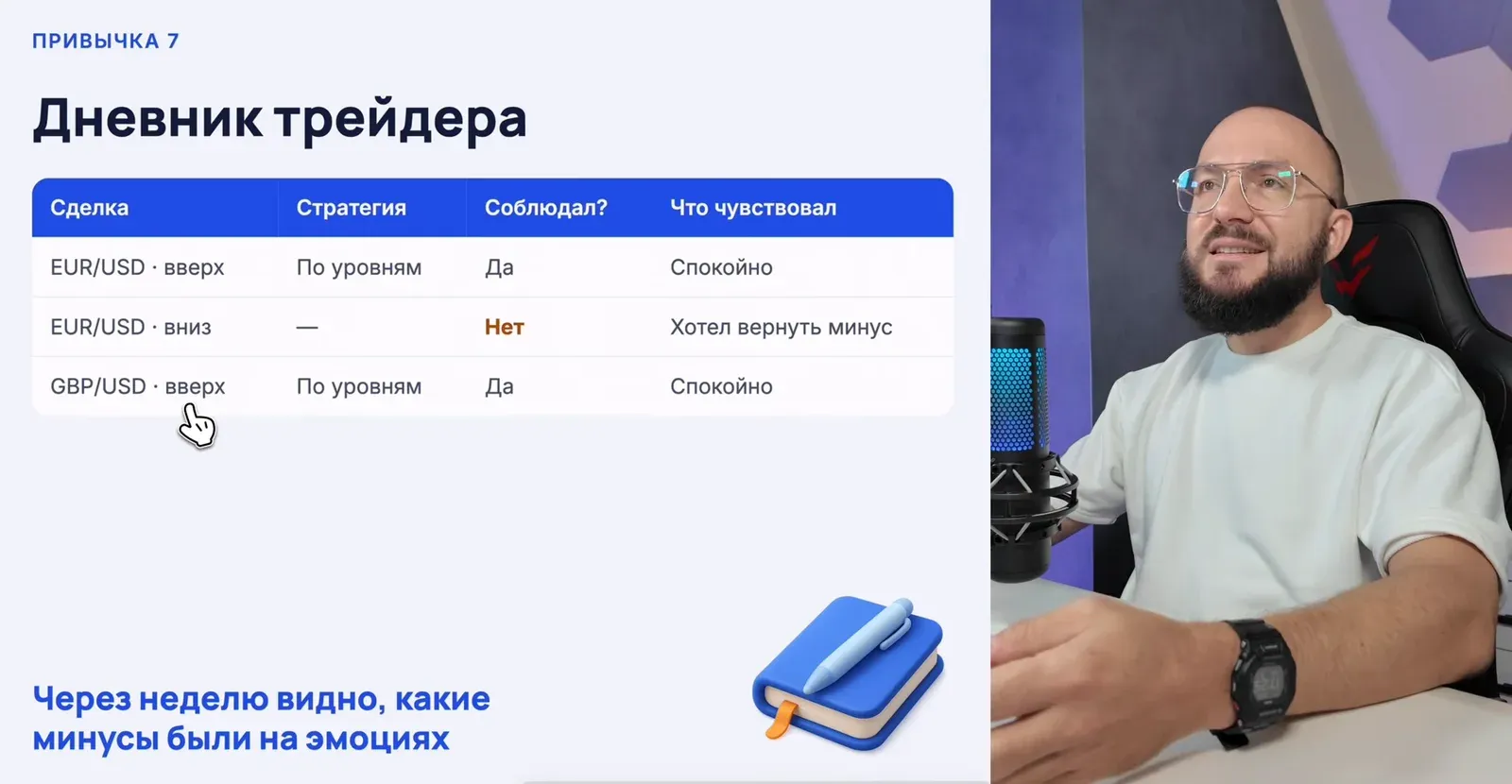
The BinoView trade manager writes trades to the journal automatically, and you can add a comment to each one: which strategy you followed, what emotions you had, what you did right. Account blocks and how emotions after them finish off a deposit are covered in a separate post, "Account blocked: why it happens and how emotions kill a deposit".
The bottom line
You can make and lose money anywhere: on crypto, on Forex, on options. The instruments differ, but the person at the terminal is always the same. Until you learn to manage yourself, no strategy will help. And once you do, even a simple strategy starts to work.
Frequently asked questions
How do I stop trying to recover a loss right after a losing trade?
Make the decision before the session, not at the moment of the loss. Set a daily stop in advance (for example, 3–5% of the deposit) and a fixed trade amount, and after every loss take a break of about ten minutes: get up from the terminal, make some tea, take a walk. A trade opened without a signal just to recover a loss is not a strategy but a reaction to discomfort. In the BinoView trade manager the stop, the target and the session timer are set in advance, and the session ends on its own.
How many trades do I need to tell whether a strategy works?
Hundreds, not three or ten. Even a good strategy with 60% winning trades has 40 losses in every 100 trades, and they do not alternate neatly: in a stretch of 100 trades a streak of at least four losses in a row occurs in about 80% of cases, and a streak of five in almost half. At a 90% payout breakeven starts at 52.6% winning trades, so judge the win rate over the long run, not the last few trades.
Can a trading bot take emotions out of trading?
A bot opens trades without emotions, but a person still makes the decisions around it. Typical mistakes: switching the bot off after the first losing test, raising amounts above the plan after a winning streak, or opening manual trades on top of the bot. Test a bot for at least three runs in a row and with amounts whose loss will not affect your life.
Author
Nick
Runs the «Много денег» YouTube channel, editor of the Academy BinoView blog.