How Much Money to Start Trading With: Deposit Math, Losing Streaks and Martingale
How much money you need to start trading binary options: why the share of the deposit in one trade matters more than the deposit itself, how many winning trades you need at a 92% and 85% payout, which losing streaks are normal for a good strategy and what martingale really requires. Worked numbers for $10, $50, $100 and $300.
 Nick 9 min read
Contents
Two traders open accounts: one with $10, the other with $300. They trade the same strategy, at the same time, on the same signals, and hit the same streak of five losses. After it the first can no longer trade, while the second keeps working to plan. The only difference is the amount and how it is managed. Below we work out step by step what the deposit size really decides, why a small deposit is more dangerous than it looks, what martingale requires and how to pick an amount that suits you.
The short answer: the share of the deposit in a trade decides
You can open an account with any amount, even $10: the broker does not forbid it. The question is what you can do with that amount. The deposit means nothing on its own; what matters is the ratio, the part of the deposit that goes into a single trade. That share decides how many losses in a row you can survive.
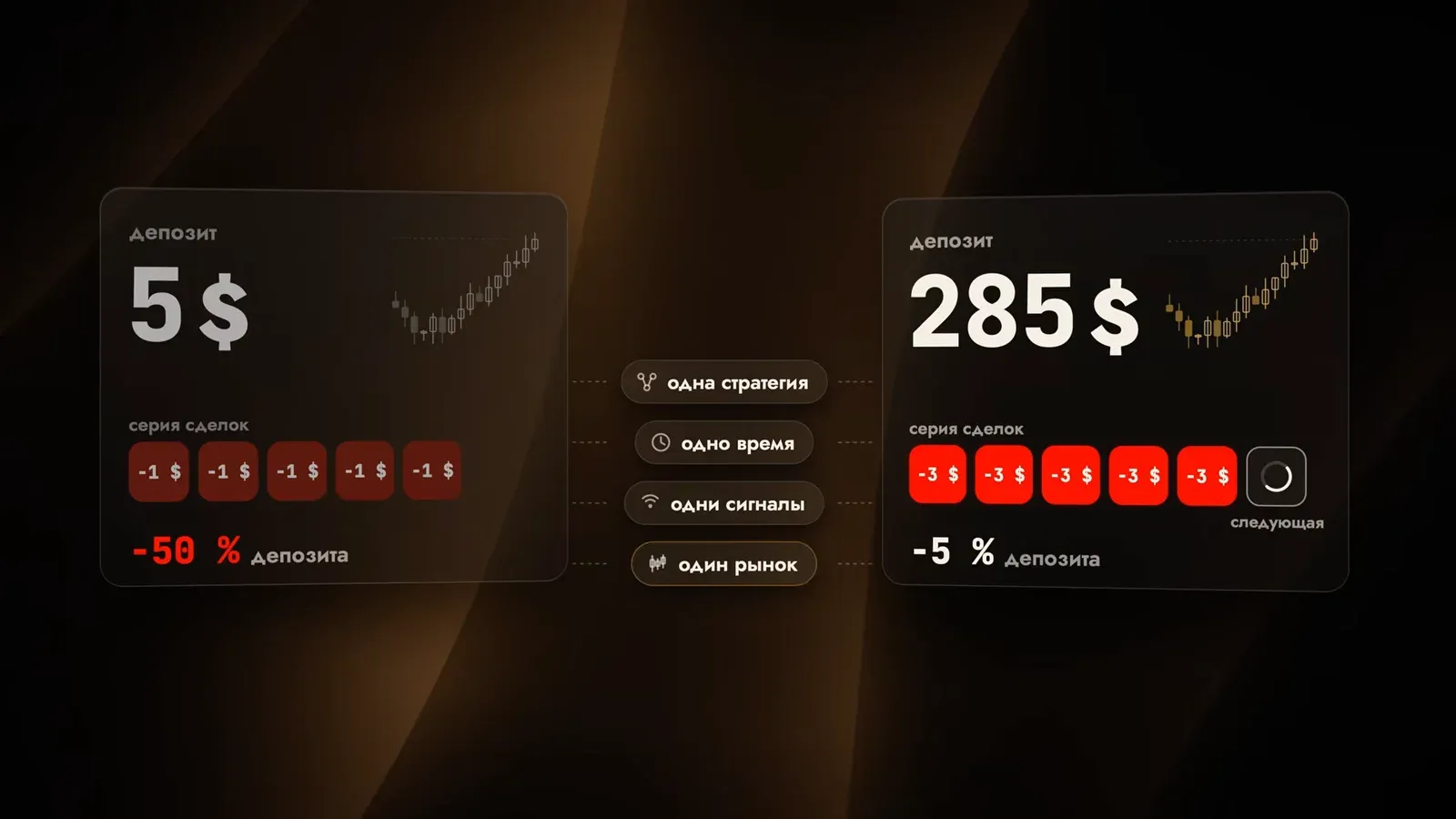
The starting point is the minimum trade size. At Pocket Option and BinoDex it is $1; a smaller trade cannot be opened.
The classic rule: 1–2% of the deposit per trade
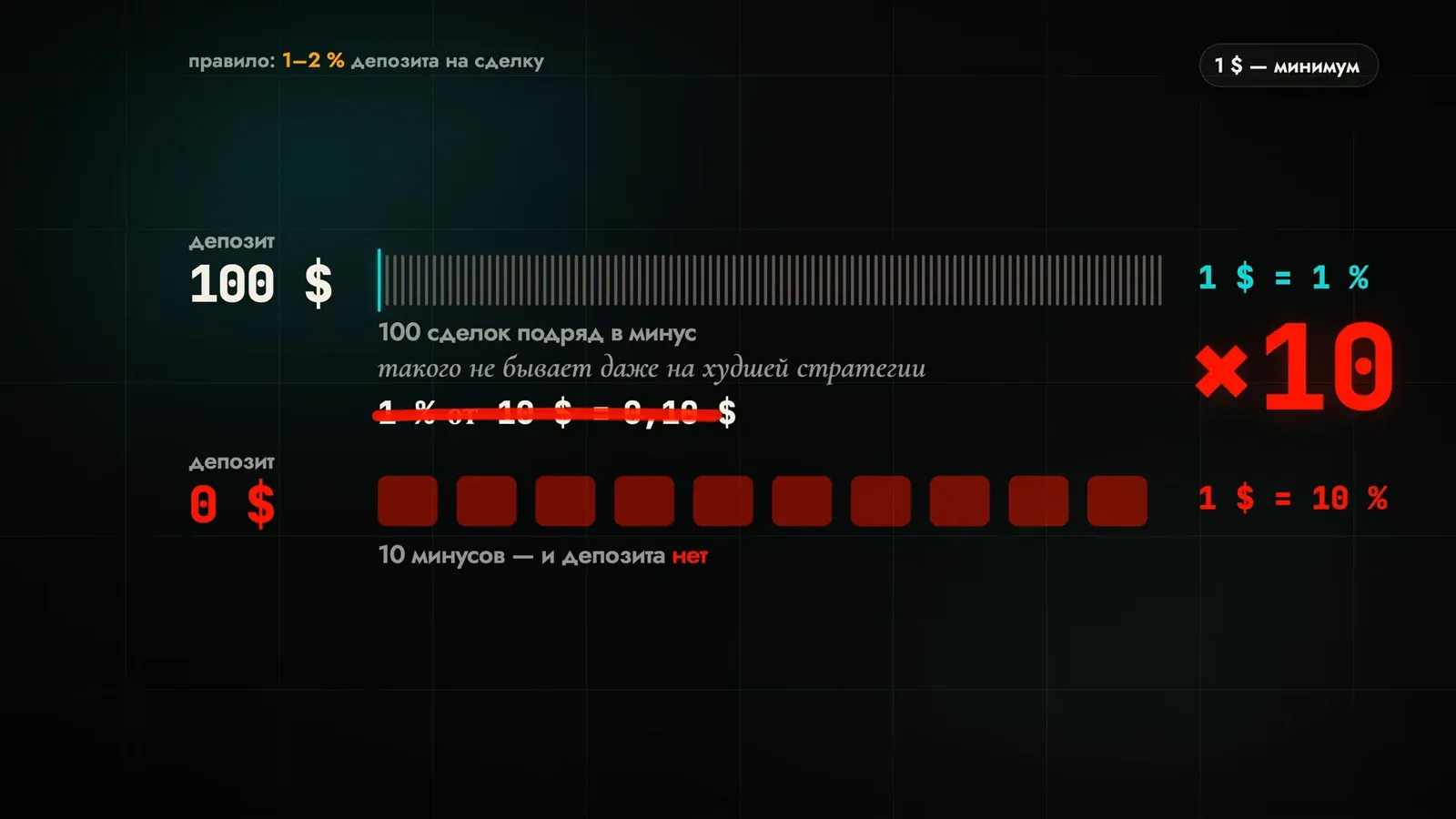
The classic money management rule is to risk 1–2% of the deposit in a single trade. It sounds dull, but here is what lies behind it:
| Deposit | Trade | Share of deposit | Losses in a row to zero |
|---|---|---|---|
| $10 | $1 (minimum) | 10% | 10 |
| $50 | $1 | 2% | 50 |
| $100 | $1 | 1% | 100 |
| $300 | $3 | 1% | 100 |
A hundred losses in a row do not happen even on a very weak strategy. Ten is a perfectly real streak. On $10 the 1% rule is physically impossible: 1% of $10 is $0.10, and such a trade cannot be opened. From the very first trade you are risking ten times the norm.
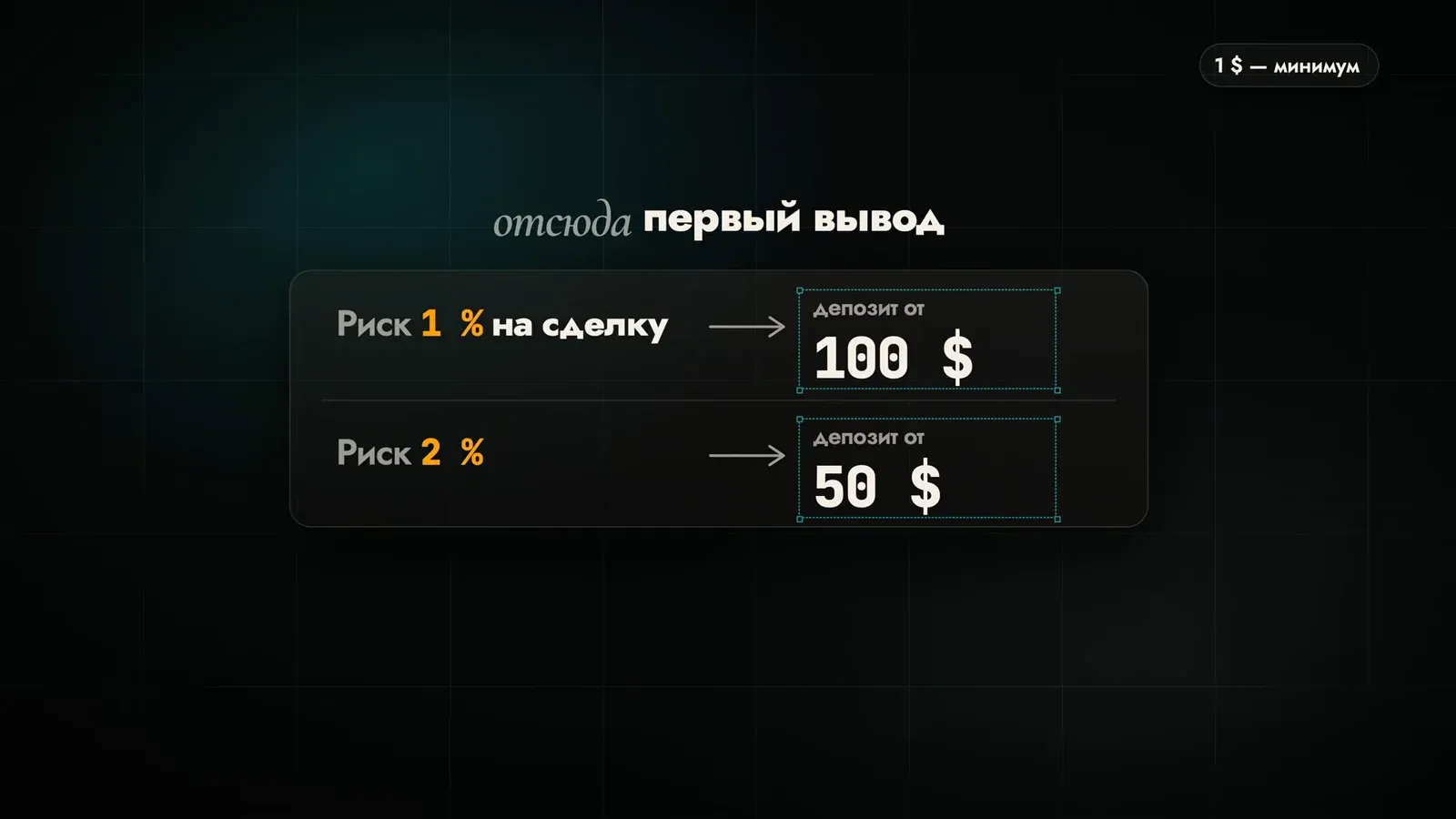
The first conclusion:
- at 1% risk per trade the minimum deposit is about $100;
- at 2% it is about $50;
- anything below that is no longer money management but trading at the limit of risk.
The general mechanics are covered in the glossary articles on the fixed amount and the fixed percentage, and the position size calculator works out the trade size for your deposit and risk.
How many winning trades you need to break even
This is rarely discussed. Take a payout of 92%: a $10 trade closes in profit, you earn $9.20. It closes at a loss, you lose the whole $10. The gain is smaller than the loss, so just to break even, more than half of your trades must be winners. The threshold is 1 / (1 + payout):
| Payout | Breakeven share of winning trades |
|---|---|
| 92% | 52.1% |
| 85% | 54.1% |
| 80% | 55.6% |
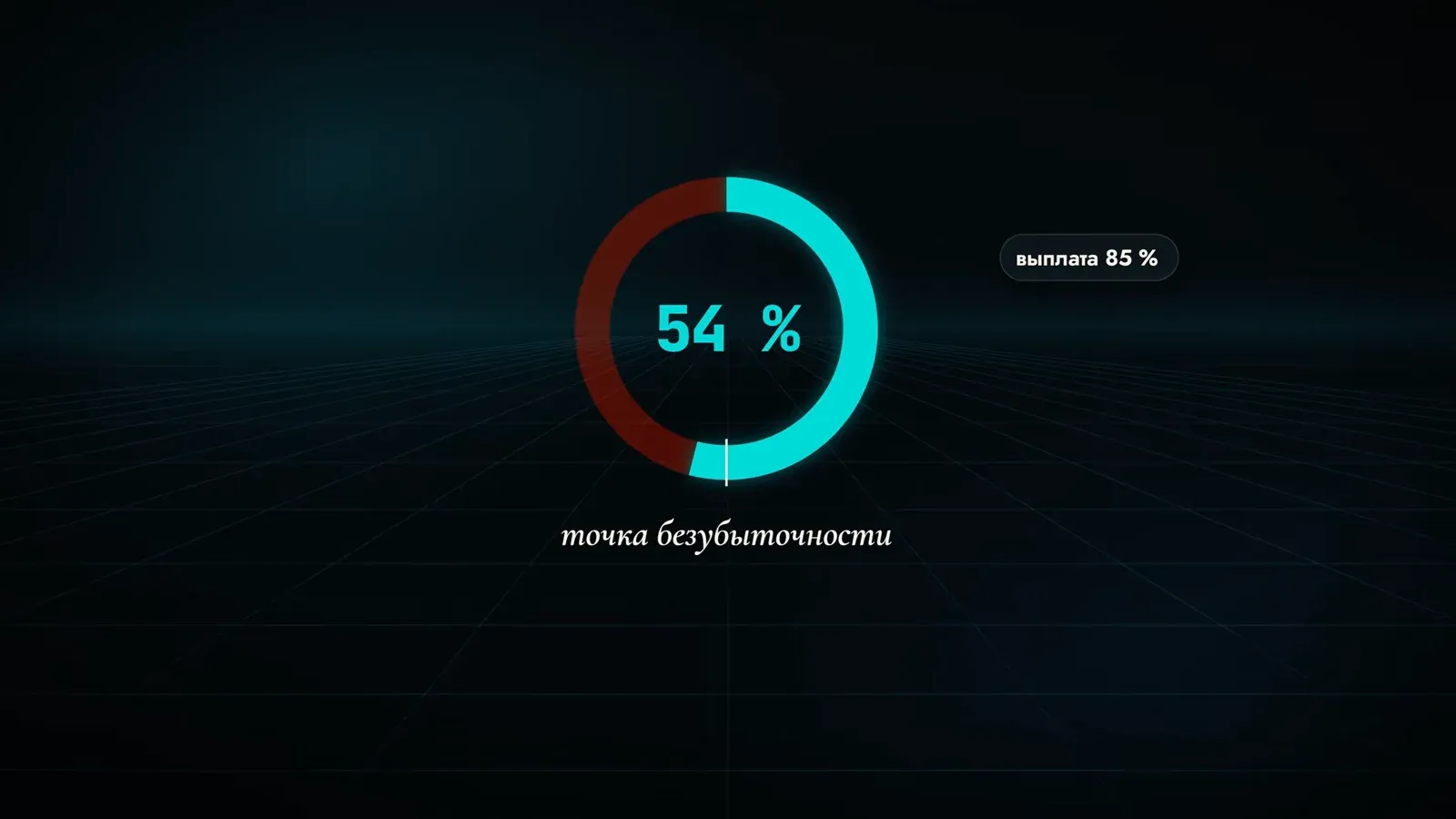
Only a strategy that delivers clearly more than half winning trades over the long run works. And the only way to check it is over hundreds of trades, not three, ten or twenty. The threshold for your payout is in the breakeven calculator; more on the metric in the article on Win Rate.
Learn for free
Losing streaks are longer than they seem
Suppose the strategy is good: 55% of trades close in profit. Streaks of five or six losses in a row are normal for it. This is not a glitch and not "the market against you", it is plain math: over 200 trades such a strategy produces streaks of six or seven losses in a row.
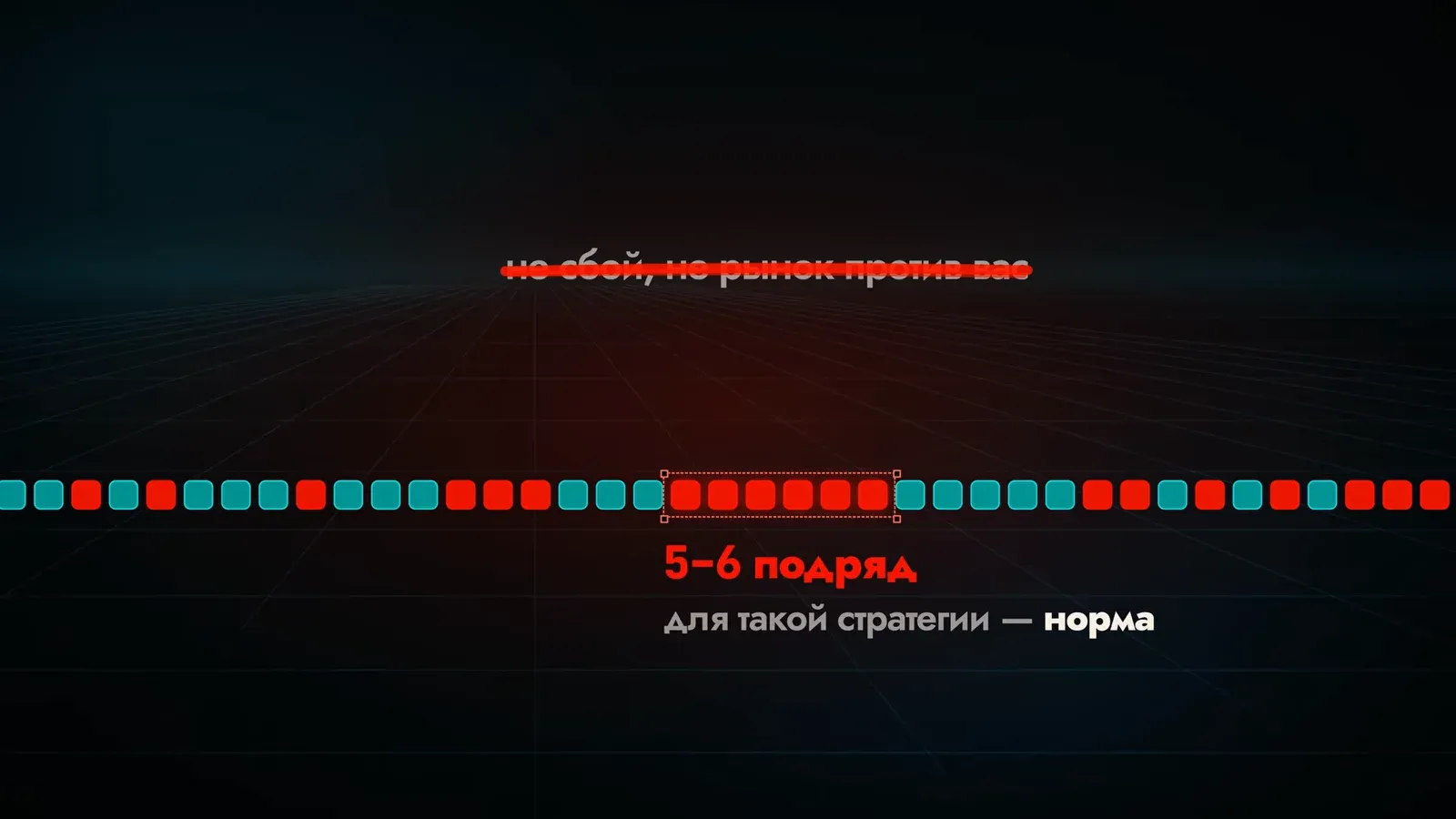
We checked this by simulating 20,000 runs of 200 trades at 55% winners. A streak of at least five losses in a row appeared in 88% of runs, at least six in 61%, at least seven in 33%. In other words, six losses in a row over such a stretch are more likely to happen than not.
Now back to the two traders, through a streak of six losses:
| $10 deposit | $300 deposit | |
|---|---|---|
| Trade | $1 | $3 |
| Six losses in a row | −$6 | −$18 |
| Share of deposit | 60% | 6% |
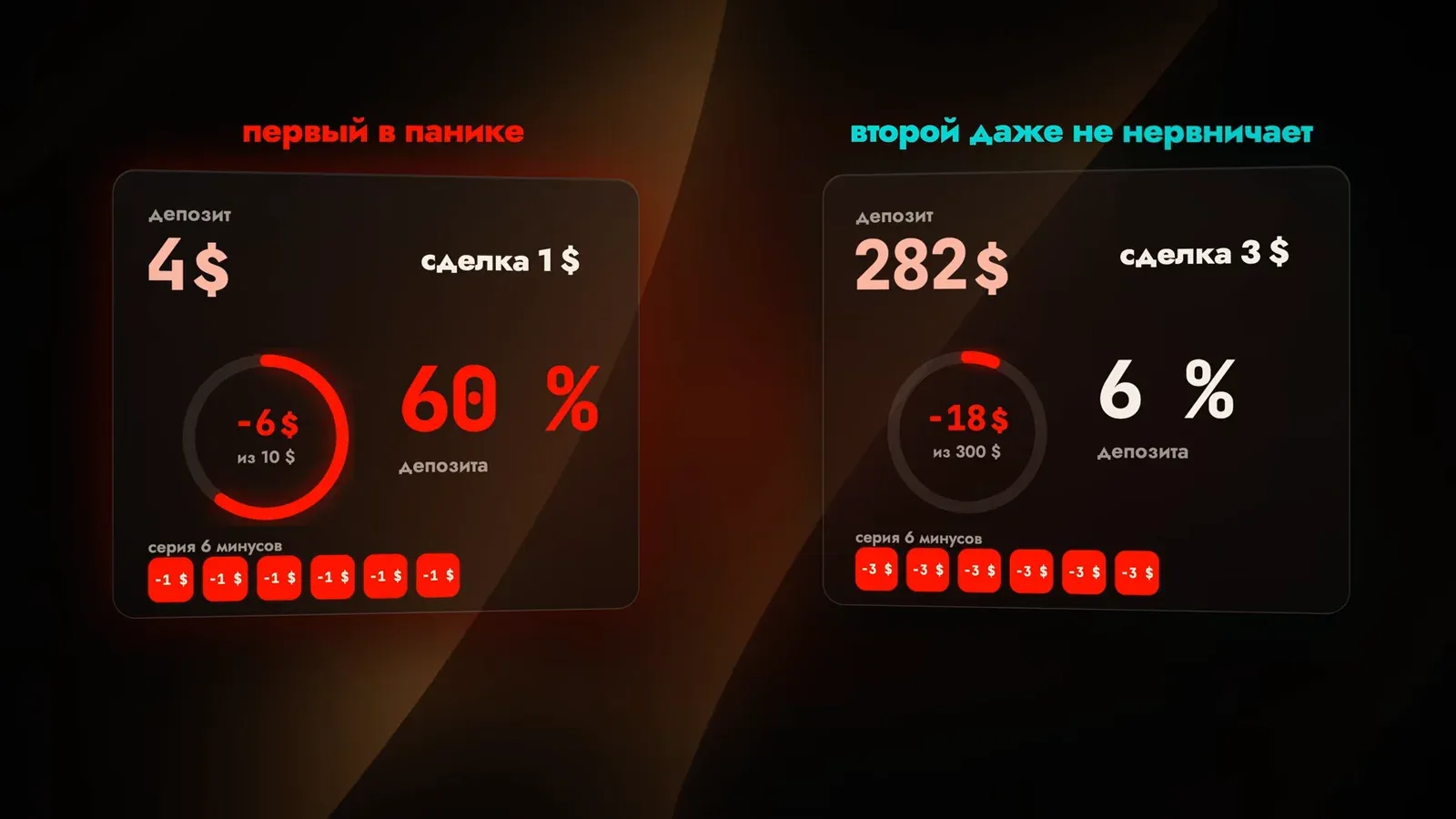
The first panics, the second is not even nervous. One strategy, completely different math. How a drawdown affects the account and why it takes longer to win back than to lose is covered in the article on drawdown.
The main problem of a small deposit is not the numbers
With $10 in the account, a winning $1 trade brings $0.92. People look at that and think, "What is the point?", and raise the trade size: $2, $5, the whole deposit. Not because the strategy says so, but because they want a result worth the time spent.
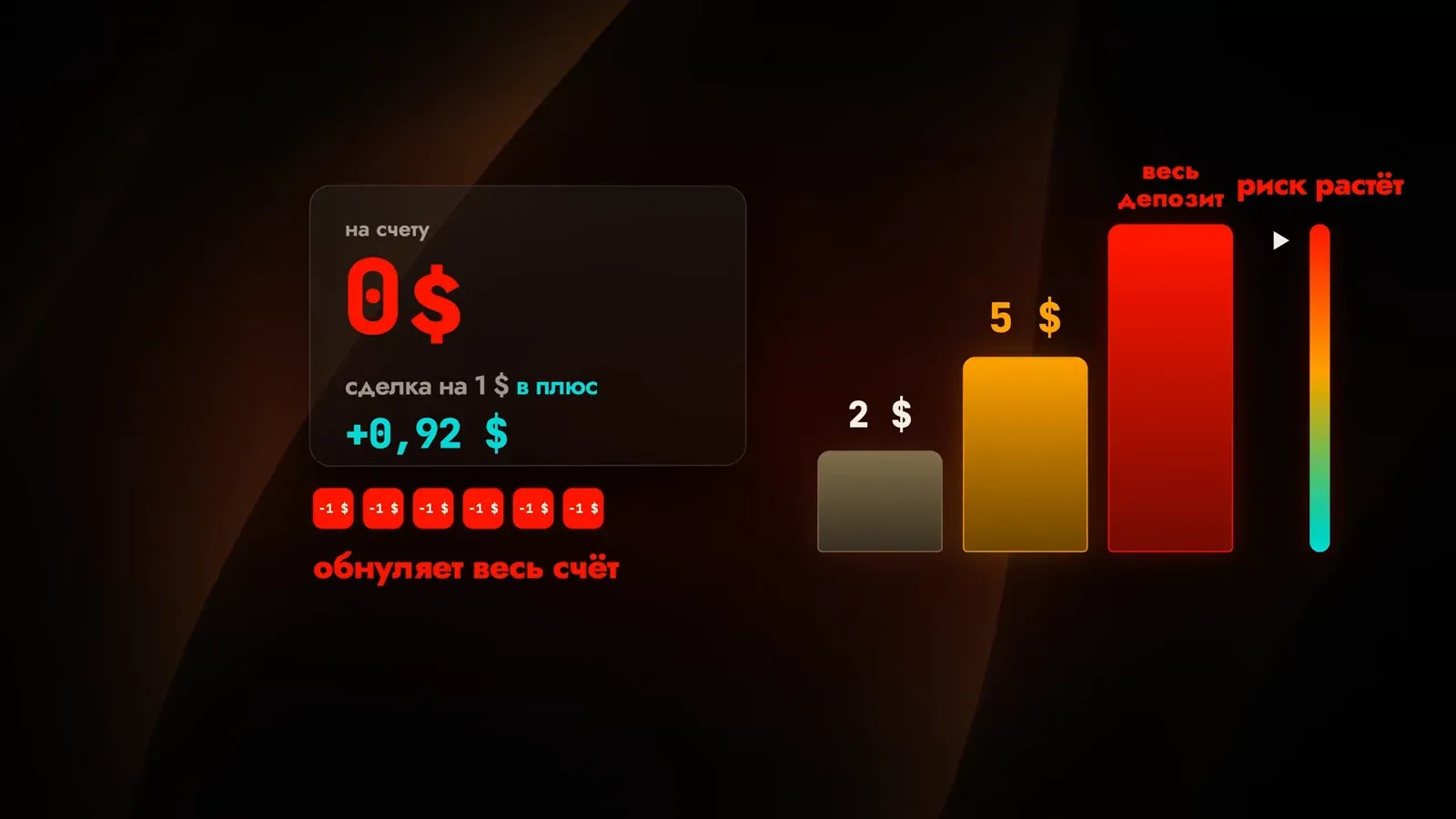
The risk grows, and a losing streak that would be a trifle on a normal deposit wipes out the account. The account gets topped up with another $10, then another, and a month later the conclusion is that trading does not work. Yet the problem was not trading: the task did not match the tool. You cannot expect a serious result from an amount on which the rules cannot be followed.
Martingale: working out the cycle
Martingale is also a money management approach: after a loss the next trade is opened for a larger amount to cover the previous loss and end up in profit. Many criticise it, many use it. It can be considered, but only if you understand how it works and what you are risking. It is a risky approach.
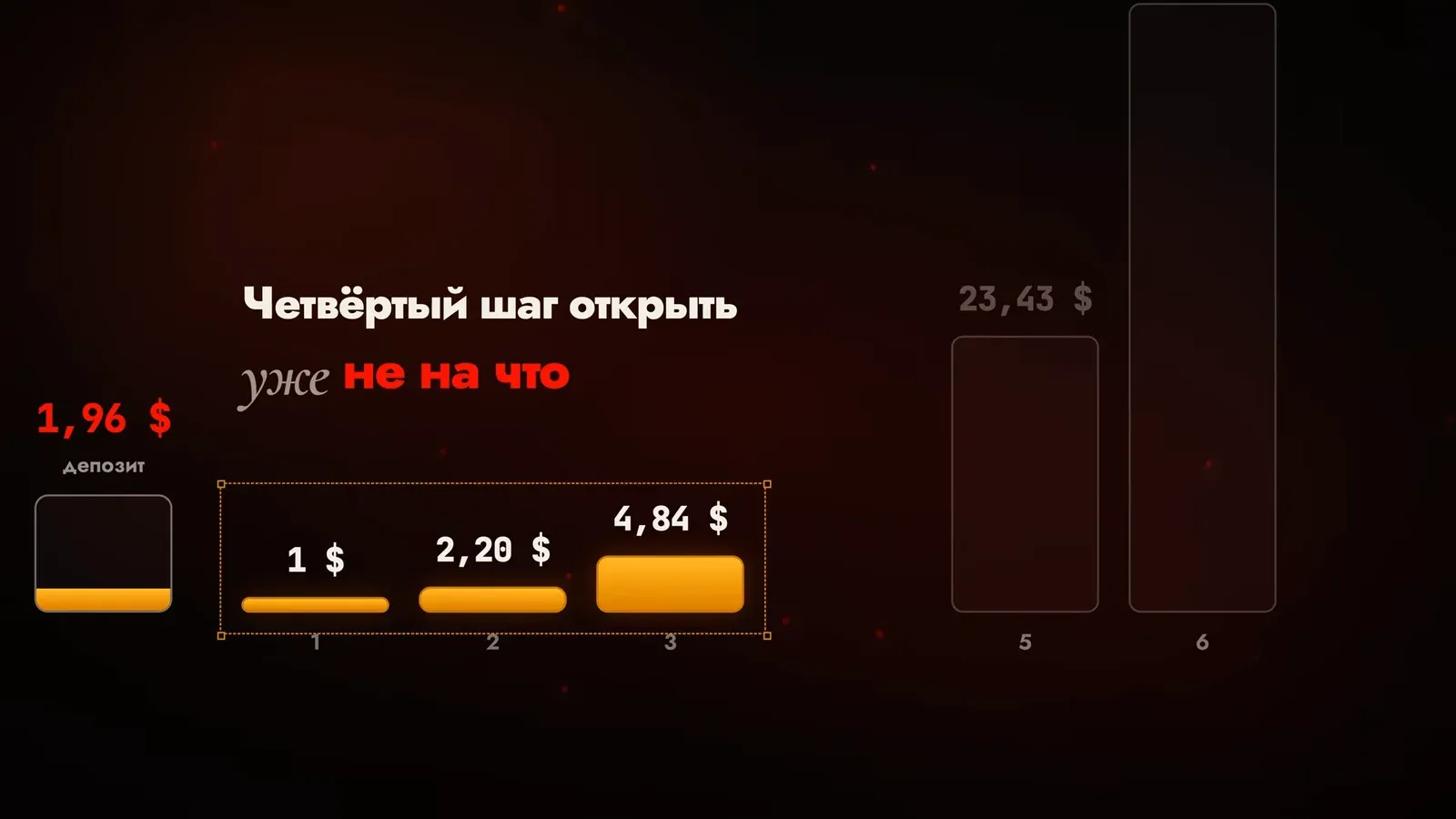
The numbers: a 92% payout, a $1 first trade, and after every loss the amount is multiplied by 2.2. A six-step cycle ends on the first winning trade or on the last step.
| Step | Trade size | Invested since the start of the cycle | Cycle result if this step wins |
|---|---|---|---|
| 1 | $1.00 | $1.00 | +$0.92 |
| 2 | $2.20 | $3.20 | +$1.02 |
| 3 | $4.84 | $8.04 | +$1.25 |
| 4 | $10.65 | $18.69 | +$1.76 |
| 5 | $23.43 | $42.11 | +$2.86 |
| 6 | $51.54 | $93.65 | +$5.30 |
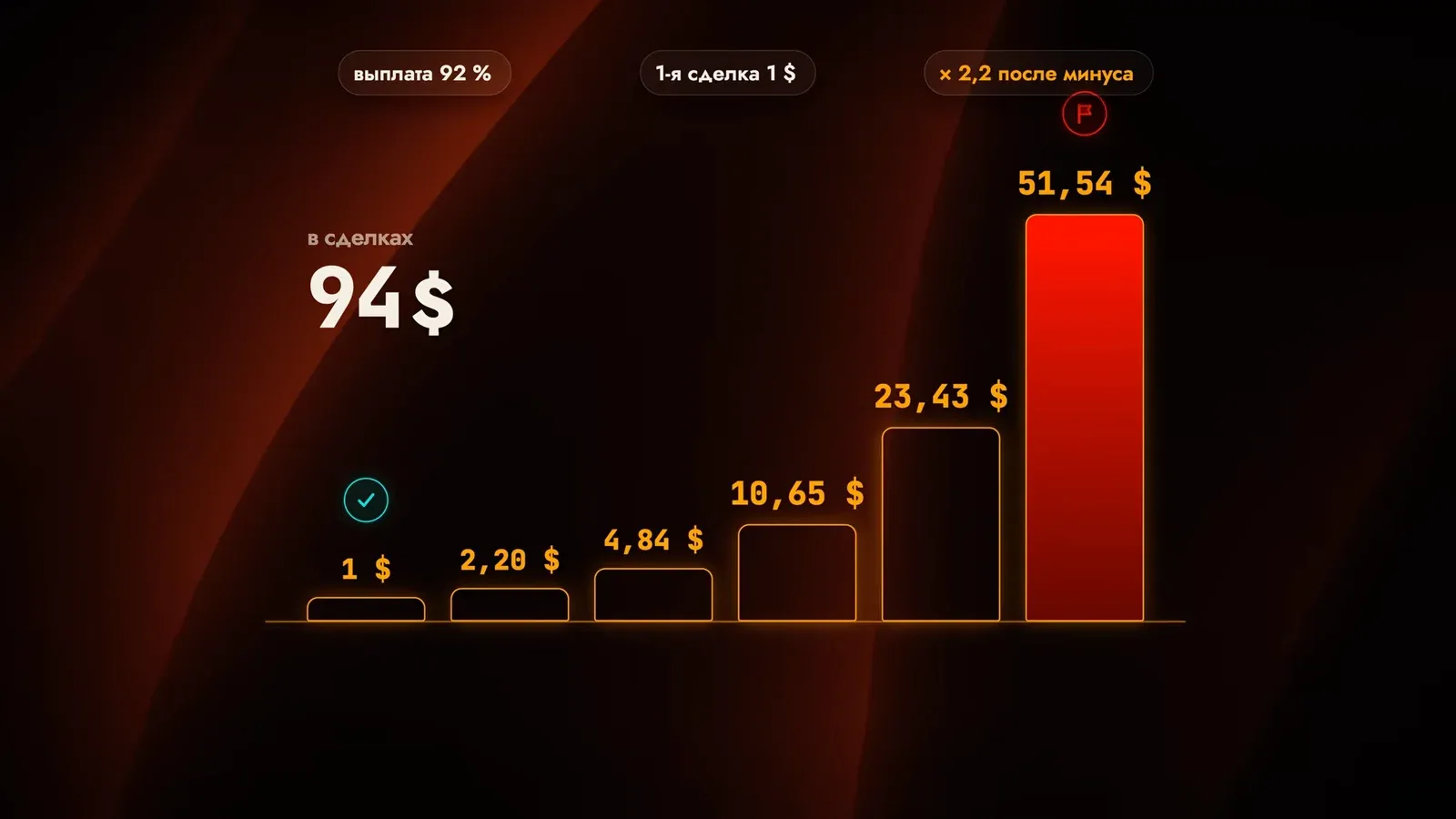
Losing the whole cycle costs $93.65, while a win on any step brings $0.92 to $5.30. A multiplier of 2.2 at a 92% payout is above the minimum that works: for a win on the next step to cover the previous losses, the multiplier must be at least 1 + 1 / payout, which is 2.09. You can work out your own variant in the martingale calculator.
What martingale does to a $10 deposit
A $10 deposit fits only three steps: $1, $2.20 and $4.84, $8.04 in total. The remaining $1.96 is not enough for the fourth step ($10.65). And a streak of five or six losses, as we have just calculated, is normal for a good strategy.
Probabilities at 55% winning trades (treating trade results as independent):
| Cycle | Whole cycle lost | Over a series of cycles | Loss each time |
|---|---|---|---|
| 3 steps ($10 deposit) | 9.1%, about 9 in 100 | at least one in 10 cycles: 61.6% | $8.04 |
| 6 steps | 0.83%, under 1 in 100 | at least one in 50 cycles: 34.1%, about a third | $93.65 |
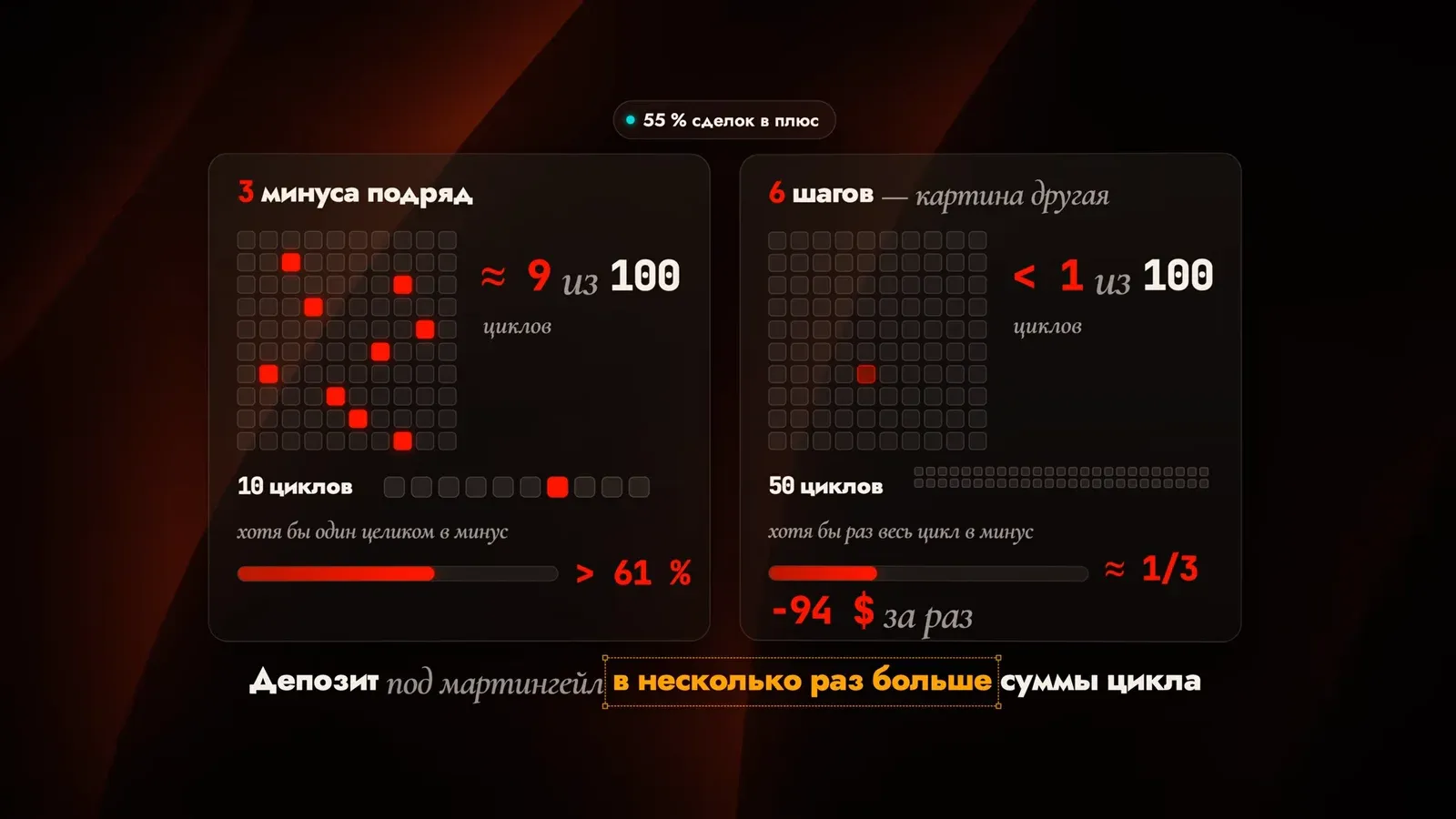
On a short cycle with a small deposit, losing a whole cycle is not an exception but the expected scenario. With six steps a full loss is rare but not zero: over 50 cycles it happens with a probability of about a third, and then the loss is about $94 at once. That is why the deposit for martingale should be several times the amount of the whole cycle.
An important caveat: a size progression redistributes the edge a strategy already has, but does not create one. If the strategy does not clear the breakeven threshold over the long run, martingale only speeds up losing the deposit.
The unexpected conclusion: martingale needs a bigger deposit
Martingale is often chosen precisely with a small deposit, to grow it fast. Yet by the numbers it needs a bigger deposit than trading a fixed amount:
- fixed amount of $1 at 1% risk: a deposit of about $100;
- martingale ×2.2 over six steps: a $93.65 cycle, and a deposit several times that amount.
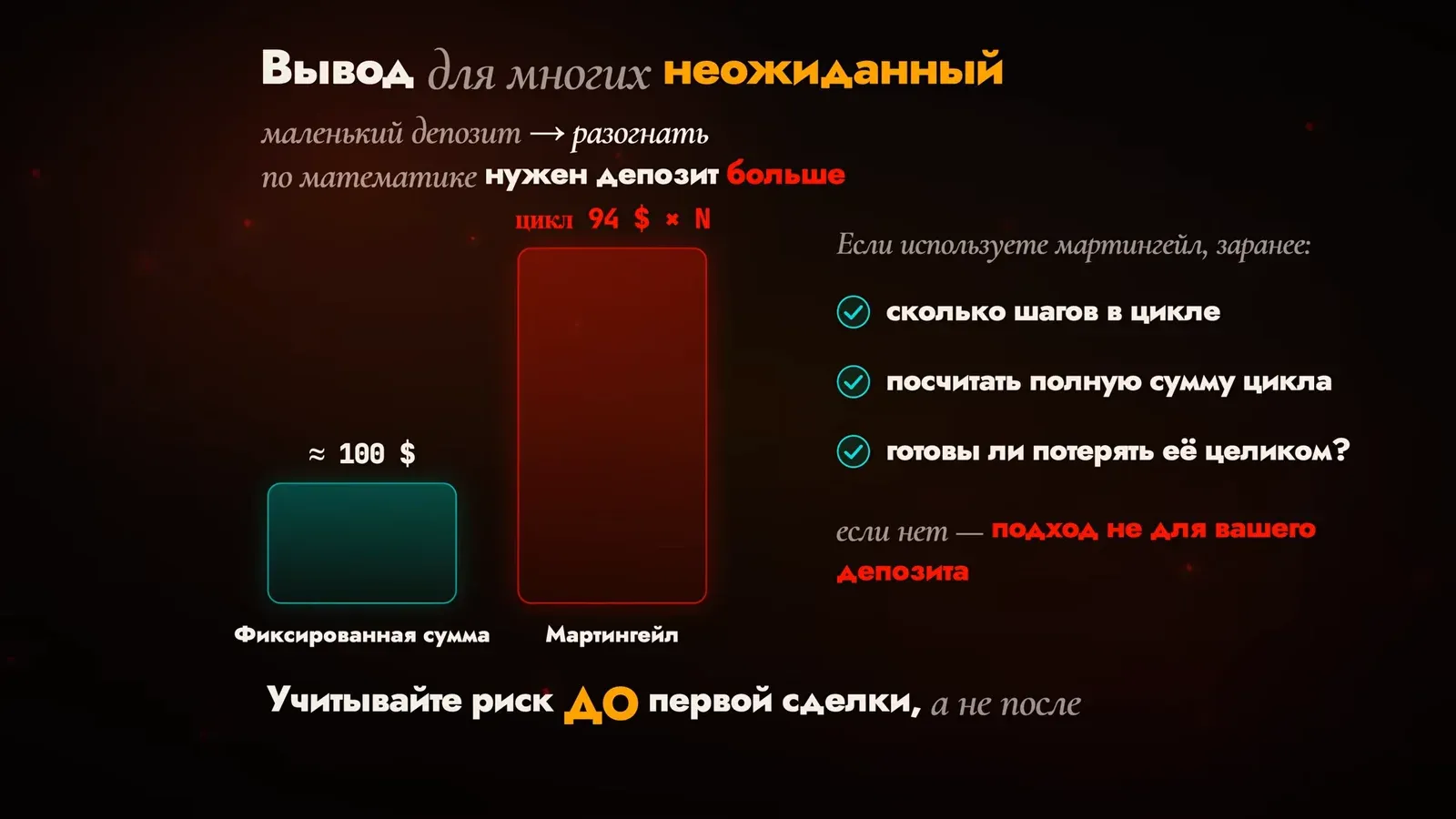
If you use martingale, before the first trade:
- Decide how many steps the cycle has.
- Work out the full amount of the cycle.
- Answer honestly whether you are ready to lose that whole amount. If not, this approach is not for your deposit.
Account for this risk before the first trade, not after. The BinoView trade manager has martingale, cascade, Masaniello, anti-martingale, recovery trading and a free strategy: the cycle is worked out in advance, and stop and take-profit targets are set visually.
How to pick the amount that suits you: three steps
- An amount you can lose without consequences for your life. Not rent money, not savings set aside for something important, not a loan and not your last money. If how you pay for your flat depends on the deposit, you will not be able to trade calmly: you will think about the loss first, every losing trade will feel like a blow, and decisions will be made on emotion.
- A money management method, and the math from it. A fixed amount of 1–2%: the deposit should be 50–100 times the trade size. Martingale: the deposit should be several times the amount of the whole cycle.
- A check of the deposit against a streak. Take six losses in a row and work out how much they will take. With a $1 trade it is $6, with a $3 trade $18. If continuing after such a streak would be hard for you, the deposit is too small for that trade size: lower the trade size or wait with the real account until you have saved more.
A daily loss limit helps you set the limit of losses for the day in advance.
If you are short of money right now
That is not a reason to drop the idea, and not a reason to hurry:
- Practise the strategy on a demo account, which is available to everyone.
- Keep a journal. Work out your share of winning trades over hundreds of trades, learn to read the chart and spot the situations where your strategy works best.
- Save up for a proper deposit while you do this work.

When you come to the real account, you will have everything at once: the amount, a tested strategy and an understanding of how to behave in a losing streak. Those who trade calmly now differ not in their starting amount, but in having decided at some point to trade by rules rather than by mood. The amount is a matter of time; the rules are a matter of your decision.
Frequently asked questions
Can I start trading with $10?
You can open an account: the minimum trade is $1, and the broker does not stop you from depositing $10. But then every trade is 10% of the deposit, and 10 losses in a row wipe out the account. The 1–2% per trade rule cannot be followed on that amount: 1% needs a deposit of about $100, 2% about $50. If you have less for now, it is wiser to practise the strategy on a demo account and save up for a proper deposit in the meantime.
Is martingale suitable for a small deposit?
No, the numbers say the opposite. A ×2.2 martingale cycle over six steps with a $1 first trade ties up $93.65, so the deposit for it should be several times that amount. A $10 deposit only fits three steps, and three losses in a row at 55% winning trades happen in about 9 cycles out of 100. Over ten such cycles, the chance that at least one is lost in full is about 62%.
What percentage of winning trades do I need to avoid losing money?
The breakeven percentage is 1 / (1 + payout). At a 92% payout it is 52.1%, at 85% it is 54.1%, at 80% it is 55.6%. Only a strategy that stays clearly above this threshold over the long run works, and you need hundreds of trades to check it: 10 or 20 trades prove nothing.
Author
Nick
Runs the «Много денег» YouTube channel, editor of the Academy BinoView blog.