BinoView Trade Manager: Six Trade-Size Strategies, a Trader's Journal and a Session Timer
An overview of the trade manager in BinoView Supercharts: martingale, cascade, Masaniello, anti-martingale, compensation recovery and free trading with the next trade's amount calculated automatically. The required balance before the start, a session target and stop-loss, a timer, a trader's journal with comments on trades, what happens when the rules are broken, and a breakdown of a Masaniello session from the video: a loss, a recovery and +$130.
 Nick 10 min read
Contents
Two $100 trades closed as losses, and instead of the strategy there is one thought in your head: minus $200, must win it back right now. That is the minute when most deposits are lost, and not because of a bad strategy but because the strategy was abandoned. The trade manager in Supercharts was built for such situations: it calculates the next trade's amount according to the chosen strategy, writes every trade into the journal and ends the session by timer or target. Below is a breakdown of all six strategies, the session settings, the journal and a demonstration on a real account.
Where it is and what it does
The manager opens with the "Manager" button in the left menu of Supercharts. It is not a calculator that helps you work something out, but an assistant that runs the trading session: you choose a trade-size strategy, press "Start session", and from then on the amount of every next trade is filled into the panel by itself. After a win or a loss all that is left to you is to analyse the chart and press the button.
Two tabs: "Trading" with the settings and the step table, "Journal" with the list of sessions and trades. The balance and account type, real or demo, are shown at the top.
Session settings
| Setting | What it does | Example from the video |
|---|---|---|
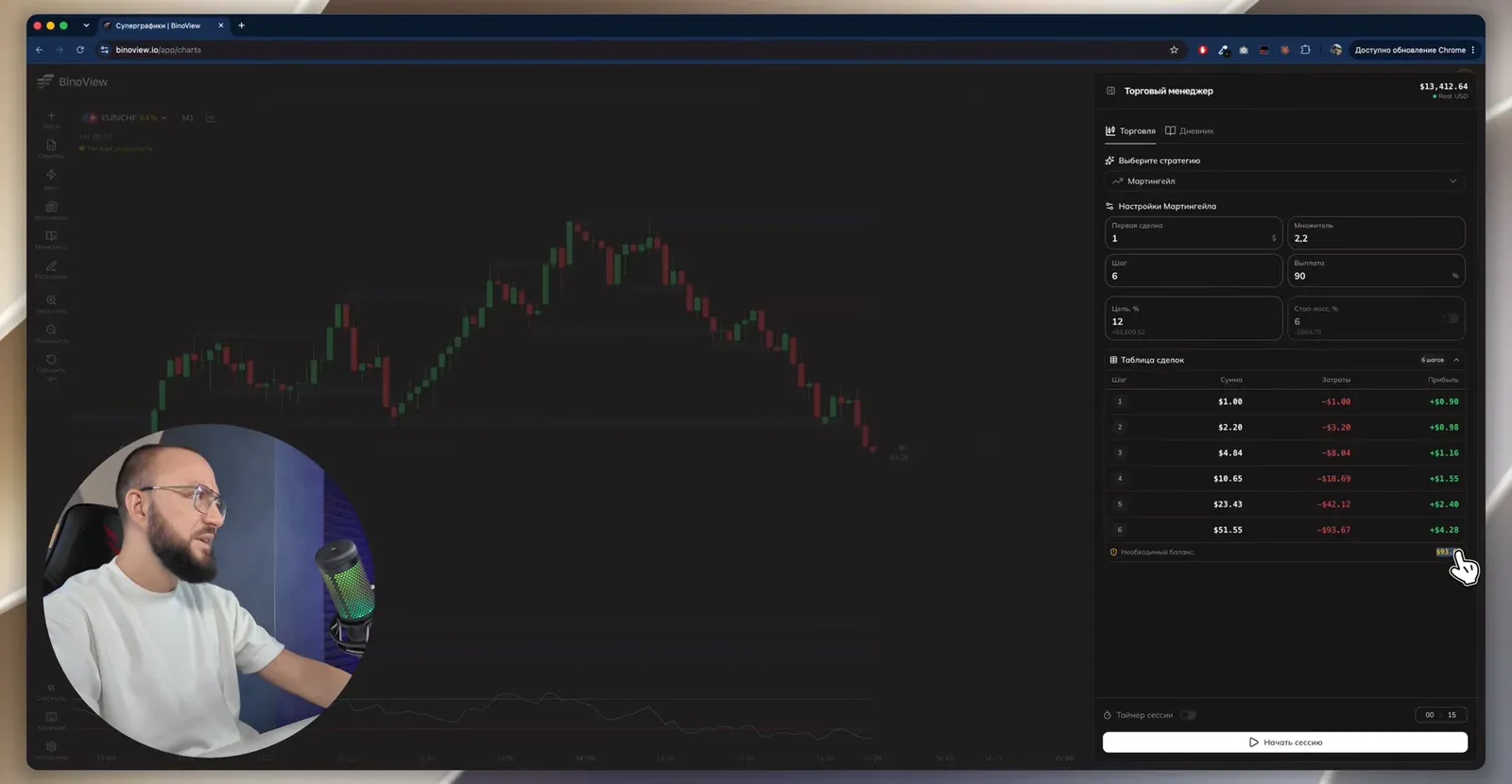
| Payout, % | used only to calculate the table, does not affect trades | at 80% the sixth martingale step closes as a loss, at 90% it gives +$4.28 |
| Target, % | profit on the deposit at which the session ends | 12% of $13,412 = +$1,609.52, at 5% +$670.63 |
| Stop-loss, % | loss on the deposit at which the session ends | 6% = −$804.76, switched off for martingale |
| Session timer | limits the session by time | 15 minutes by default, 30 in the video |
| Required balance | the sum of all steps in the series | $93.67 for 6 steps, $10,714.44 for 12 |
On the martingale stop-loss the video is blunt: it is a redundant setting, because the stop is set by the number of steps. Martingale is limited to six steps; more only in tests or for a bot with a modest hit rate, where the risk is capped by the required balance anyway.
For a beginner the timer matters more than the target. A 30-minute session ends by itself: whether the last trade closed as a win, did not make it, or no trade was opened at all. If the session closed as a loss, that is a signal to pause until the evening or the next day and come back with a clear head rather than "dig deeper". More on why such an external stop is needed in the article on the daily loss limit.
Trade Manager and other tools — in BinoView Supercharts
The six strategies
| Strategy | What you set | Example from the screen |
|---|---|---|
| Martingale | first trade, multiplier, number of steps | $1 × 2.2, 6 steps: 1 → 2.20 → 4.84 → 10.65 → 23.43 → $51.55, bank $93.67 |
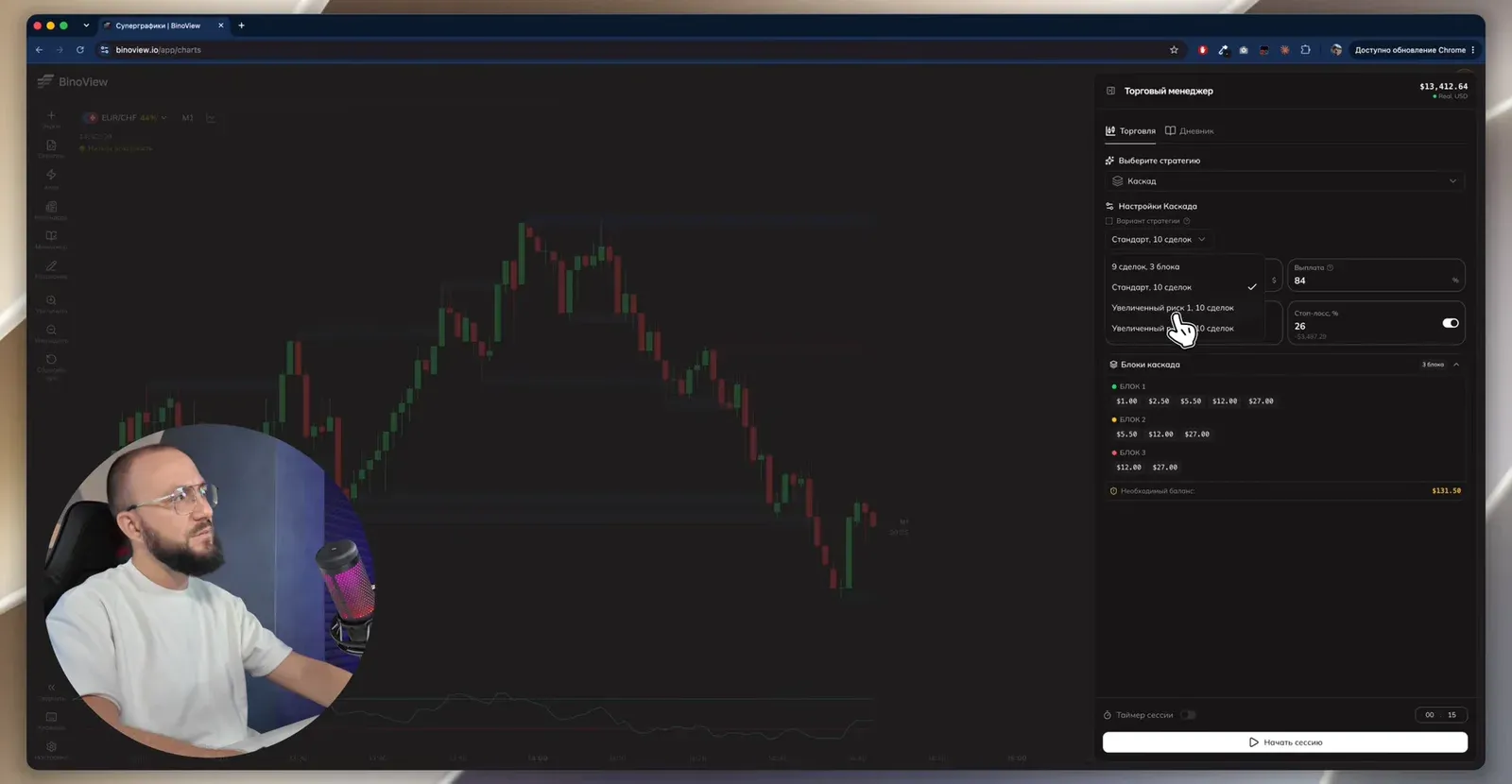
| Cascade | block variant, first amount | "Standard, 10 trades": blocks $1–2.50–5.50–12–27, $5.50–12–27 and $12–27, bank $131.50 |
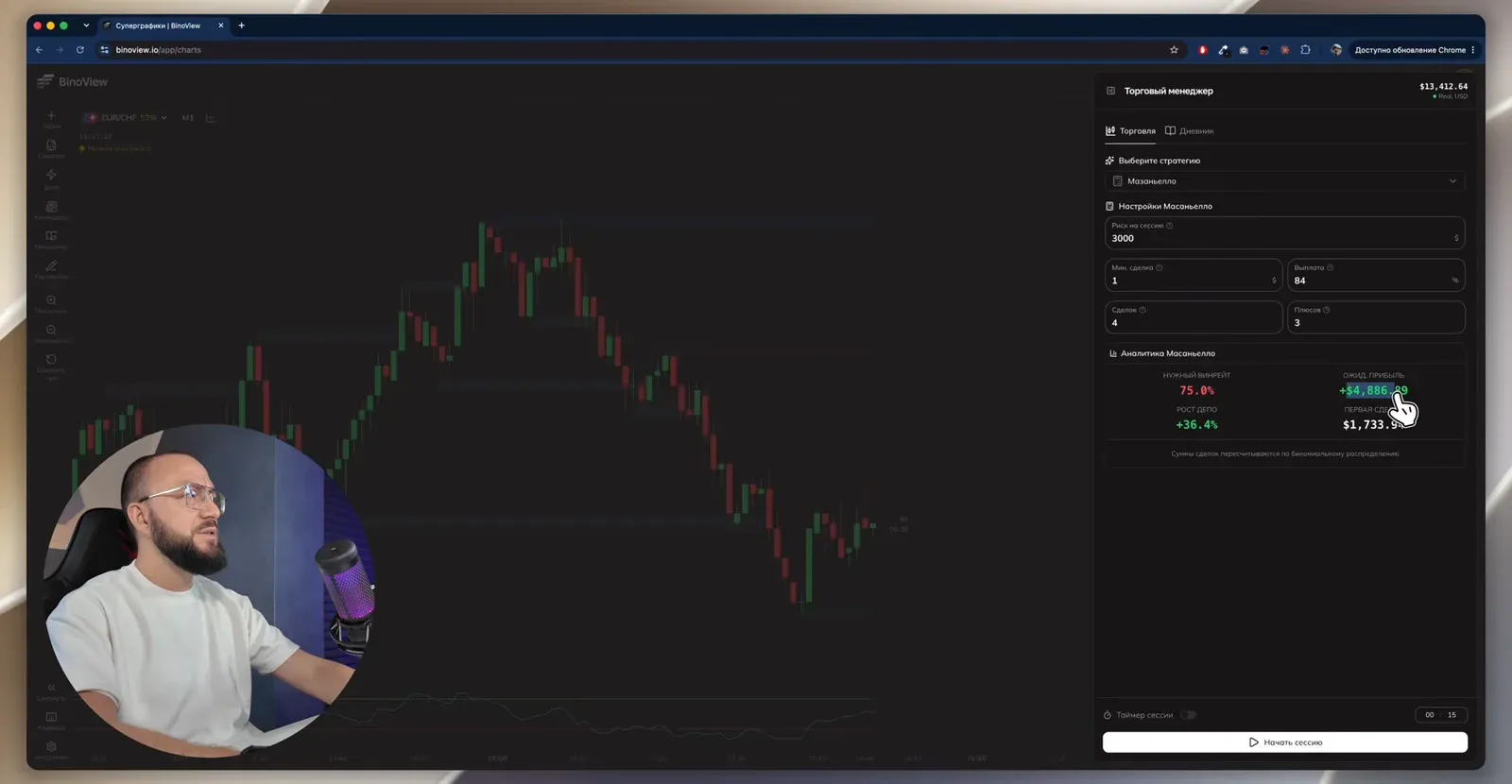
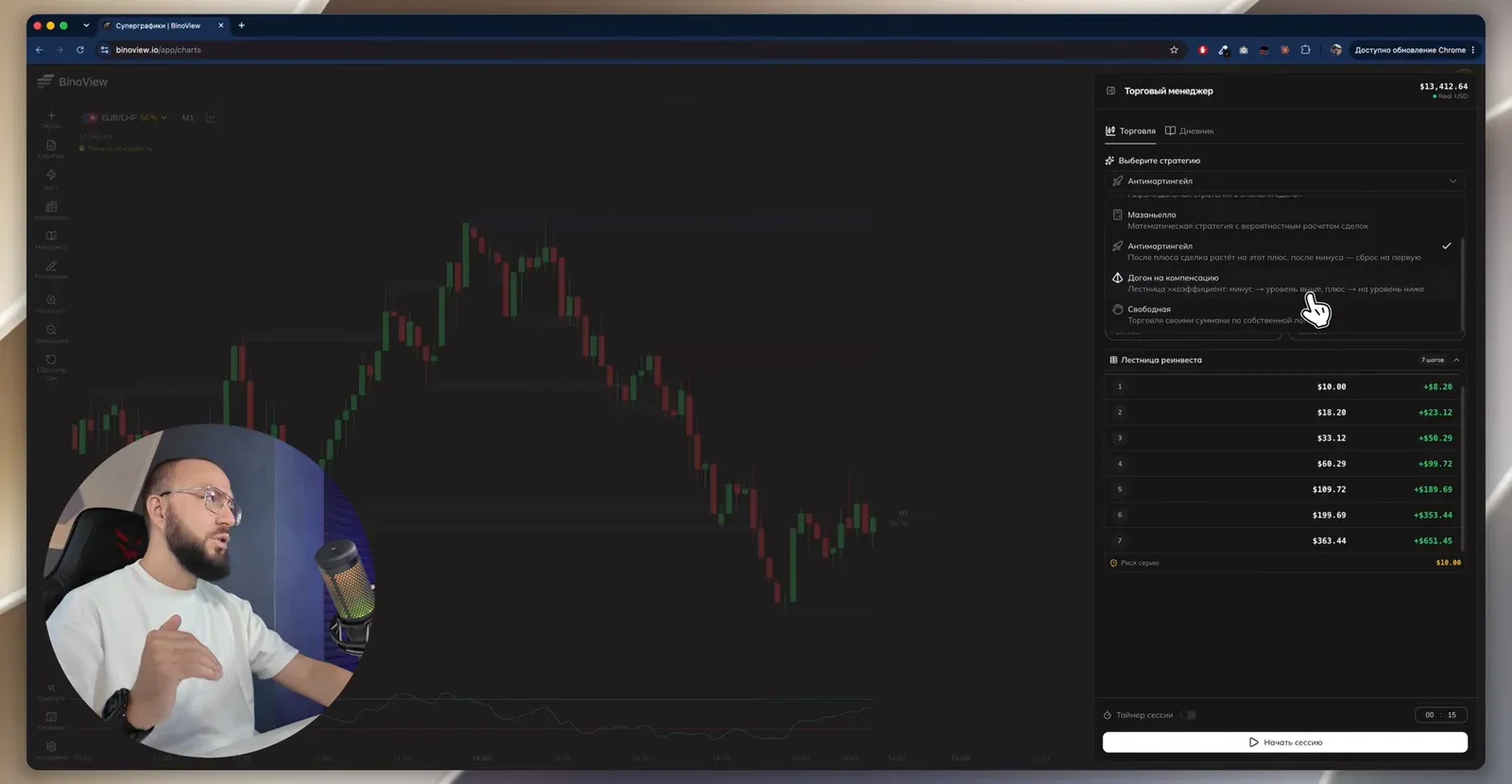
| Masaniello | per-session risk, minimum trade, number of trades and wins | $3,000, 6 trades, 3 wins: first trade $624.38, expected profit +$1,088.06 |
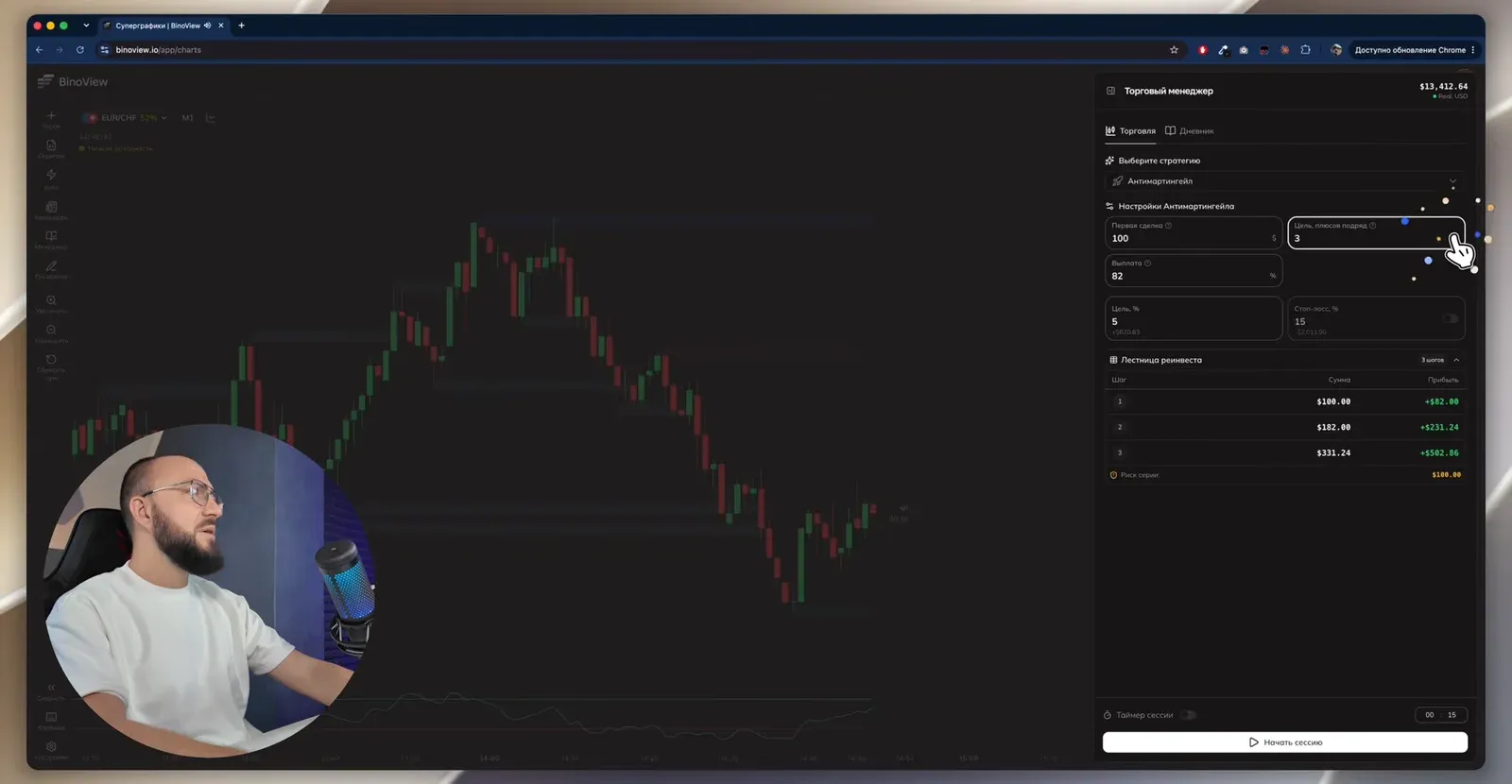
| Anti-martingale | first trade, target of wins in a row | $100, 3 wins at an 82% payout: 100 → 182 → $331.24, series profit $502.86, risk $100 |
| Compensation recovery | first amount, coefficient, number of levels | coefficient 1.3, up to 13 levels |
| Free | you choose the amount yourself | $100, 92% payout |
Martingale is the riskiest: after every loss the amount is multiplied by the coefficient, and the first win covers the series. The manager shows the step table and the required balance, which grows like an avalanche: six steps need $93.67, twelve already $10,714.44 at the same $1 base. How the calculation works is covered in the article on the recovery trade, and your own figures come from the martingale calculator.
Cascade is gentler: the series is split into blocks, in the standard variant five, three and two trades. If the first block is all losses and a win comes in the second, the manager returns to the previous block and covers it with a small amount: the move from block to block is smooth, without one huge step. The variants on screen: "9 trades, 3 blocks", "Standard, 10 trades", "Increased risk 1" and "Increased risk 2". The first amount can be changed, and the blocks are recalculated.
Masaniello is the only strategy where the per-session risk is set up front: for example, $3,000 of a $13,412 deposit. Then we set the number of trades and how many of them must close as wins, and the manager calculates the first trade and the expected profit by the binomial distribution. The more realistic the target, the smaller the amount and the profit: 13 trades with three wins need a win rate of 23.1%, a first trade of $12.56 and an expected profit of +$14.32. Four trades with three wins already need 75%, a first trade of $1,733 and an expected profit of +$4,886. If the trades run on assets with different payouts, the algorithm pulls the amounts towards the expected profit on its own.
Anti-martingale is the mirror of martingale: the amount grows after a win and resets to the first after a loss. We set a target of wins in a row: at $10 and three wins the series risk is $10 and the profit $50. Did not work, try again: three attempts cost $30. Seven wins in a row at the same $10 would give $651, but the chance of reaching the seventh step is noticeably lower.
Compensation recovery is a ladder with a coefficient: a loss moves you one level up, a win one level down. The recommended coefficient is 1.3, up to 13 levels. The amount flows smoothly from step to step, without doublings.
Free is for those who trade a fixed amount or a progression of their own: you choose the amount of every trade yourself, and the manager only writes the trades into the journal and counts the session.
The trader's journal
Every trade closed as a win or a loss in an active session goes into the "Journal" tab. Per session you see the strategy, date, result and a counter of wins and losses; inside, per trade, the time, expiration, asset, direction, progression step, amount and result. Filters: today, 7 days, 30 days, all, and separately the real and demo accounts. In the video the overall result for all time is +$14,082.21 over 300 trades at a 57% win rate, and over seven days +$4,912.41 over 70 trades.
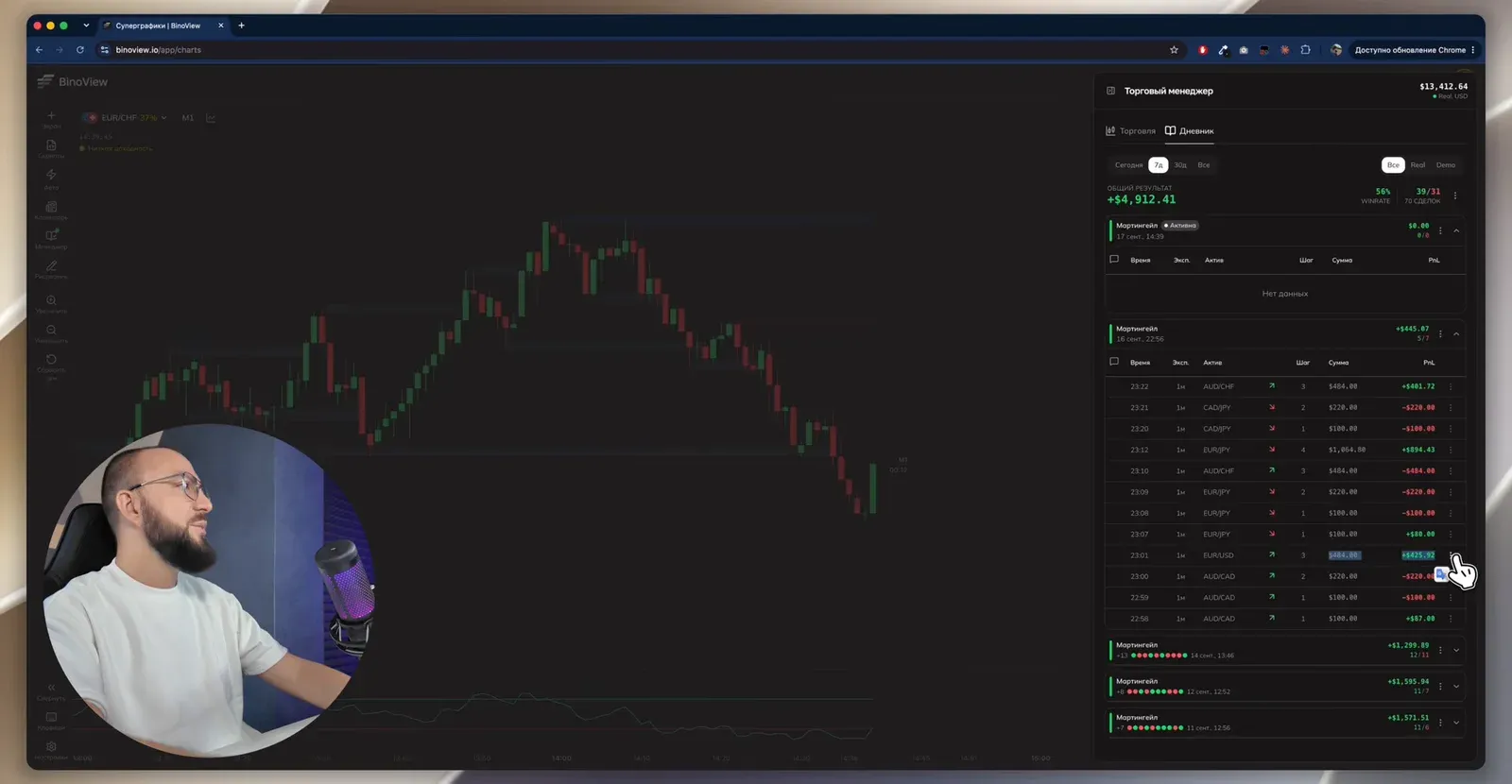
Every trade can be edited: fix the amount if it was recorded incorrectly, and leave a comment on which strategy you traded, what emotions there were, what you did right and what you did not. A comment is written for the session as well: what distracted you, why you closed. The point is to open the session a week later and see the reason for a loss instead of reconstructing it from memory. Why this matters and what to write is covered in the article on money management.
Breaking the rules
The manager does not forbid opening a trade with a different amount: press $21.13 instead of $2, and the trade opens and is recorded. But the next amount is filled in as the strategy requires, and the breach remains yours. Open five $1 trades instead of one $2 trade, and one goes into the journal. The rule from the video: broke the rules, go to the journal, edit the trade, enter the real amount and the comment "should have been one, opened three". It switches your head on and makes you see the mistake instead of forgetting it.
Breakdown of the Masaniello session from the video
- Choose Masaniello, a per-session risk of $3,000, six trades, three wins. First trade $624.38, expected profit about +$1,088, required win rate 50%.
- Press "Start session". On screen: first trade of six, three wins needed, at a loss the next amount is $824.
- A sell on the levels + DeMarker setup, entered slightly late on an impulse. A loss of $624.
- The manager fills in $824. A recovery from the same resistance, a win.
- Result: +$130.58 over two trades, the session capital $3,130.58 of $3,000, two trades of six done, two more wins needed. The next trade is $676.82, at a loss $931.31. The session is closed: the aim of showing the mechanics is done.
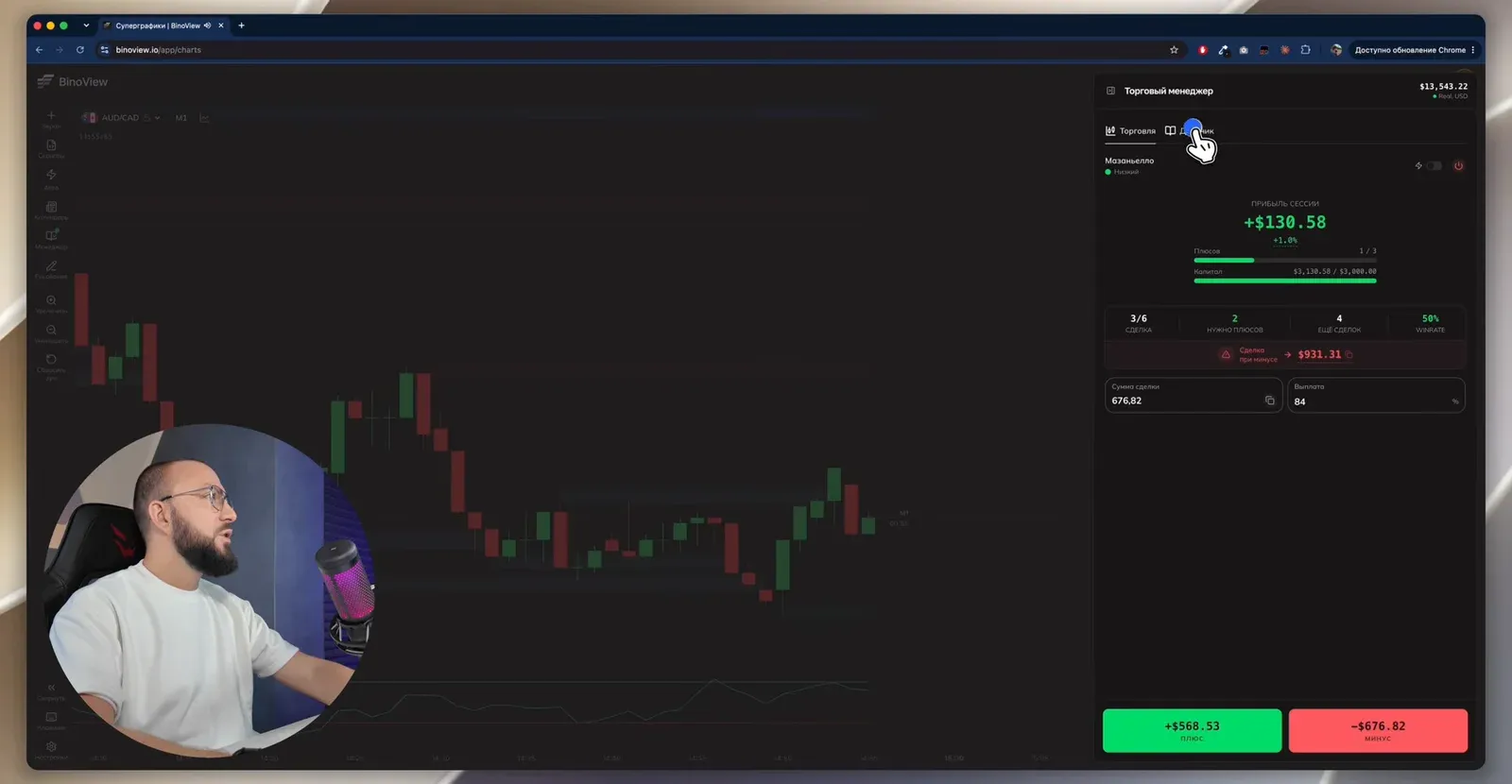
This is a demonstration of the mechanics, not the strategy's result: one loss and one win say nothing about profitability. What it does show is the main thing: after every trade the manager recalculated the amounts itself, and the trader's decision came down to finding a situation on the chart. How Masaniello spreads the risk over a series can be explored in the Masaniello calculator.
FAQ
Why a manager if I can calculate the trade amount myself?
It has to be calculated not once but after every trade, and precisely at the moment of a loss, when maths is the last thing you want to think about. The manager fills in the next trade's amount itself, shows the required balance before the start and ends the session by timer or target. Plus every trade goes into the journal without manual entry, and the statistics per strategy build up on their own.
What happens if I open a trade with an amount other than the one the manager filled in?
The trade opens and is recorded correctly in the journal, but the manager does not account for the breach: the next amount is filled in as the strategy requires. If three trades were opened instead of one $100 trade, one goes into the journal, and it has to be edited: enter $300 and the comment "broke the rules". That is the point of the record: to see exactly where you departed from the plan.
Can I keep the journal without a trade-size strategy?
Yes, that is what the "Free" strategy is for: you choose the amount of every trade yourself, and the manager only writes the trades into the journal and counts the session result. It suits trading with a fixed amount or testing a progression of your own that is not in the list.
Author
Nick
Runs the «Много денег» YouTube channel, editor of the Academy BinoView blog.